
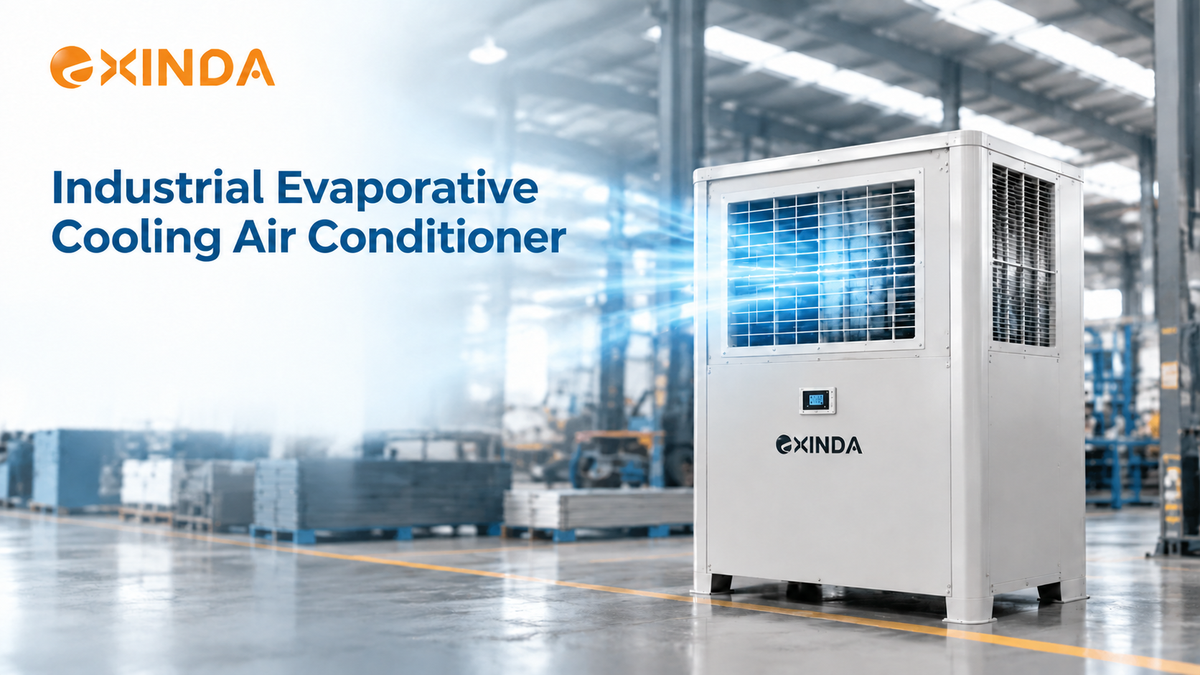
Energy-Efficient Cooling Solutions for Large Industrial Spaces
Industrial Evaporative Cooling Air Conditioner systems are becoming an efficient cooling solution for factories, warehouses and commercial facilities across Southeast Asia.
Southeast Asia has become one of the world's major manufacturing regions, with thousands of factories, warehouses, logistics centers and commercial facilities operating in hot and humid climates. For these large spaces, traditional air conditioning systems may require high installation costs and significant energy consumption.
For these large spaces, traditional air conditioning systems may require high installation costs and significant energy consumption, while simple evaporative coolers may not provide sufficient cooling stability in humid environments.
EXINDA industrial evaporative cooling air conditioners are designed as a professional cooling solution combining DX refrigeration technology with evaporative cooling assistance, providing efficient cooling, large airflow coverage and flexible installation options for industrial applications.
What Type of Cooling System Is an Industrial Evaporative Cooling Air Conditioner?
Unlike traditional evaporative coolers that rely only on water evaporation and airflow, EXINDA industrial evaporative cooling air conditioners integrate a refrigeration system with evaporative cooling technology.
The system includes:
- Refrigeration circuit
- Compressor
- Heat exchanger
- Fan system
- Water circulation components
The evaporative cooling process helps improve heat exchange efficiency, while the DX refrigeration system provides stable cooling capacity.
This combination allows the system to deliver reliable cooling performance for factories and industrial buildings where airflow coverage and operating efficiency are critical.
How Does Evaporative-Assisted DX Cooling Technology Work?
The cooling process combines two technologies:
1. DX Refrigeration Cooling
The refrigeration system removes heat through:
- Compressor
- Refrigerant circulation
- Evaporator coil
This provides stable cooling capacity measured in kW.
2. Evaporative Cooling Assistance
Water evaporation is used to improve heat exchange efficiency.
The evaporative process helps reduce heat load on the cooling system and improves performance, especially in high-temperature industrial environments.
The result is:
- Efficient cooling operation
- Reduced energy consumption potential
- Better performance for large spaces
Designed for Large Airflow Coverage
Industrial cooling is not only about temperature reduction.
For factories and warehouses, the key challenge is:
How to deliver cooling airflow across large working areas.
EXINDA industrial evaporative cooling air conditioners are available with different airflow configurations:
| Model Range | Cooling Capacity | Airflow | Typical Application |
|---|---|---|---|
| 5HP | 22kW | 4000m³/h | Small and medium factories |
| 7HP | 28kW | 5000m³/h | Workshops and warehouses |
| 10HP/12HP | 50kW | 10000m³/h | Large industrial spaces |
Different air delivery designs provide flexibility:
Long Throw Airflow Design
For open factories and workshops.
Features:
- Air throw distance up to 18–25m
- Suitable for large working zones
- Helps distribute cooling air over longer distances
Applications:
- Manufacturing plants
- Production lines
- Industrial workshops
Cabinet Air Supply Design
For localized cooling areas.
Features:
- Direct installation
- Easy maintenance
- Suitable for smaller industrial spaces
Applications:
- Repair areas
- Assembly zones
- Commercial workshops
Ducted Air Distribution Design
For customized projects requiring multiple air outlets.
Features:
- Flexible duct layout
- Suitable for new construction projects
- Better integration with building design
Applications:
- Industrial facilities
- Commercial buildings
- Large warehouses
Is Evaporative Cooling Suitable for Southeast Asia?
Southeast Asia includes countries with high temperatures and high humidity, such as:
- Thailand
- Vietnam
- Malaysia
- Philippines
- Indonesia
For industrial applications, cooling requirements are different from residential air conditioning.
Factories and warehouses often require:
- Large airflow
- Worker comfort improvement
- Equipment environment control
- Lower operating costs
Evaporative-assisted DX cooling systems can be considered for:
✓ Manufacturing facilities
✓ Logistics warehouses
✓ Industrial workshops
✓ Commercial open spaces
A professional site evaluation should consider:
- Outdoor temperature
- Relative humidity
- Building structure
- Heat sources
- Required airflow distribution
Installation Considerations
EXINDA industrial evaporative cooling air conditioners support different installation approaches:
Floor Standing Installation
Suitable for:
- Existing factories
- Workshop upgrades
- Local cooling applications
Hanging Installation
Suitable for:
- High ceiling buildings
- Large open spaces
Duct Connection Installation
Suitable for:
- Project-based applications
- Multi-zone cooling requirements
Customization and Project Support
For industrial projects, cooling requirements vary depending on:
- Factory layout
- Production equipment
- Working area
- Electrical requirements
EXINDA supports project-based solutions including:
- Airflow configuration
- Installation method selection
- Electrical adaptation
- Control integration discussion
Before selecting a system, customers should provide:
- Application type
- Factory or warehouse size
- Ceiling height
- Location and climate conditions
- Power supply requirement
- Cooling target area
Why Choose EXINDA Industrial Cooling Solutions?
EXINDA develops HVAC solutions including:
- Industrial evaporative cooling systems
- Air-source heat pumps
- ERV ventilation systems
- Commercial HVAC solutions
With engineering experience in international HVAC projects, EXINDA supports distributors, contractors and project partners looking for reliable industrial cooling solutions.
FAQ
Is an industrial evaporative cooling air conditioner the same as a portable evaporative cooler?
No.
Industrial evaporative cooling air conditioners are engineered HVAC systems designed for factories, warehouses and commercial applications. They are different from portable evaporative coolers for small spaces.
Can evaporative cooling systems work in Southeast Asia?
Yes, especially for industrial applications where large airflow and energy-efficient cooling are required. Proper system selection should consider local humidity, building structure and cooling requirements.
What is the difference between evaporative cooling and traditional air conditioning?
Traditional air conditioning relies mainly on refrigeration cycles. Evaporative-assisted systems combine refrigeration technology with water evaporation assistance to improve cooling efficiency and airflow performance.
CTA
Looking for an Industrial Cooling Solution in Southeast Asia?
EXINDA provides industrial evaporative cooling air conditioners for factories, warehouses and commercial projects.
Contact EXINDA for project evaluation and customized cooling solutions.


