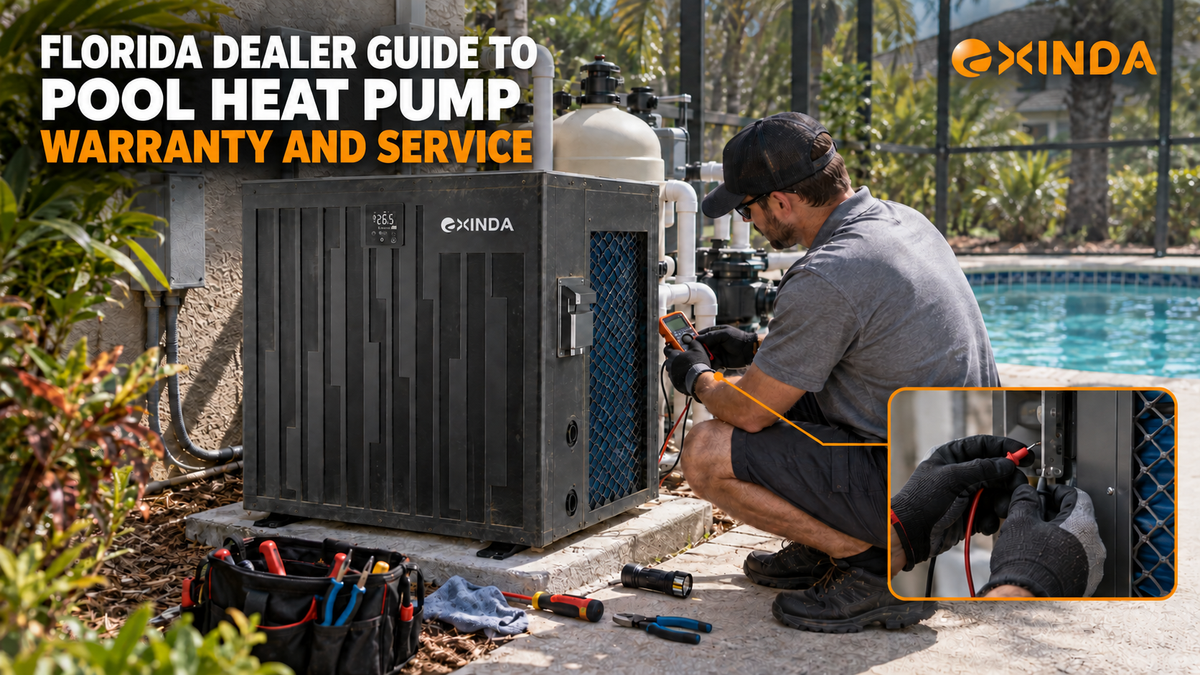
A pool heat pump warranty should clerly explain what is covered, how claims are handled, who diagnoses a failure and how quickly replacement parts can be supplied. For Florida pool equipment dealers and distributors, the number of warranty years alone does not show whether a supplier can provide practical service support.
Florida’s long swimming season, high humidity, coastal air and frequent pool operation can expose weaknesses in equipment selection, installation and after-sales procedures. Before adding a pool heat pump line, dealers should evaluate the complete support system behind the product—not just the warranty headline.
Why Pool Heat Pump Warranty Support Matters to Florida Dealers
A warranty issue affects more than the equipment owner. It can require a dealer to arrange a site visit, diagnose the unit, communicate with the supplier, order parts and explain the resolution to the customer.
If the warranty process is unclear, the dealer may absorb unexpected costs, including:
-
Technician labor
-
Repeat service visits
-
Replacement components
-
Expedited freight
-
Equipment removal or reinstallation
-
Customer communication
-
Damage to the dealer’s local reputation
A strong supplier should therefore provide written warranty terms and a workable process for technical diagnosis, parts identification and claim approval.
1. What Exactly Does the Pool Heat Pump Warranty Cover?
Dealers should ask for a written warranty schedule before placing an order. The document should separate the coverage for the complete unit from the coverage for major components.
Important questions include:
-
How long is the complete unit covered?
-
Does the compressor have a separate warranty period?
-
Are the heat exchanger, control board, fan motor, sensors and other components covered?
-
Does the warranty include replacement parts only, or also labor?
-
Who pays the freight for warranty parts?
-
When does the warranty period begin?
-
Is product registration required?
-
Are commercial and residential installations covered differently?
EXINDA’s current North American pool heat pump literature lists a 10-year compressor warranty for the relevant 65,000–150,000 Btu/h models. Dealers should request the current written warranty schedule for the selected model and order because compressor coverage does not automatically define coverage for the complete unit, labor or freight.
2. What Conditions Can Make a Warranty Claim Ineligible?
A useful pool heat pump warranty should state its exclusions clearly. Dealers should not have to discover these conditions after a failure occurs.
Common conditions that may affect warranty eligibility include:
-
Incorrect electrical supply or circuit protection
-
Insufficient water flow
-
Operation outside the specified ambient range
-
Improper installation clearances
-
Restricted airflow or hot-air recirculation
-
Freeze damage
-
Chemical damage caused by incorrect pool water balance
-
Unauthorized repairs or modifications
-
Damage during transportation or handling
-
Failure to follow maintenance requirements
The supplier should also explain what evidence is required during a claim. This may include the serial number, installation date, operating readings, alarm code, photographs, video or technician diagnosis.
3. How Does the Supplier Diagnose a Service Problem?
A pool heat pump supplier should have a defined troubleshooting process. Asking a dealer to replace parts without confirming the cause can increase costs and result in repeat failures.
Before selecting a supplier, ask whether technical support can provide:
-
Alarm-code explanations
-
Electrical and refrigerant troubleshooting guidance
-
Water-flow checks
-
Sensor resistance or voltage references
-
Wiring diagrams
-
Component identification
-
Controller and parameter guidance
-
Remote review of photographs, videos and operating data
Smart controls can also help with initial diagnosis. EXINDA inverter pool heat pumps include controller fault indication, and Wi-Fi control is available for applicable configurations. Actual remote diagnostic functions should be confirmed for the selected controller and model.
4. Are Spare Parts Available and Easy to Identify?
A long warranty has limited practical value if the correct replacement component cannot be identified or delivered.
Florida dealers should ask a supplier:
-
Which spare parts are recommended for local stock?
-
Is there a model-specific spare-parts list?
-
Are parts linked to serial numbers or production versions?
-
How are control board and software versions identified?
-
Are common service components included with dealer orders?
-
What happens when a component is revised?
-
Are replacement parts supplied with installation instructions?
A practical dealer stock may include sensors, flow switches, controllers, control boards and other frequently serviced electrical components. The correct list should be based on the selected models, local sales volume and the supplier’s service recommendations.
5. Does the Supplier Provide Complete Technical Documentation?
Technical documents are part of after-sales support. A brochure alone is not enough for installation, commissioning and troubleshooting.
Dealers should request the following before launching a product line:
-
Technical submittal
-
Installation and operation manual
-
Wiring diagram
-
Water-flow requirements
-
Recommended circuit protection
-
Product dimensions and service clearances
-
Exploded parts diagram
-
Alarm-code list
-
Commissioning checklist
-
Warranty claim procedure
-
Model-specific certification documents
The information should match the exact product supplied. Dealers should avoid relying on a general manual that combines products with different capacities, electrical configurations or control systems without clear model identification.
6. Is the Product Suitable for Florida Operating Conditions?
Florida pool heat pumps operate in hot, humid and sometimes coastal environments. Dealers should verify the equipment’s operating limits and corrosion protection rather than relying on a general “all-climate” statement.
EXINDA’s 65,000–150,000 Btu/h inverter pool heat pump range is designed for heating and cooling and uses R32 refrigerant, twin-rotary inverter compressors and corrosion-resistant titanium heat exchangers. The current product data lists an ambient operating range of 14°F to 110°F.
The range includes suggested covered-pool applications from approximately 10,000 to 42,000 gallons, depending on model. These volume ranges are preliminary selection references—not substitutes for a project-specific calculation. Actual selection should consider:
-
Pool volume and surface area
-
Target water temperature
-
Minimum and maximum ambient conditions
-
Required heat-up time
-
Wind exposure
-
Pool cover usage
-
Hours of operation
-
Available electrical supply
-
Installation airflow
-
Required water flow
The supplier should help the dealer select the correct capacity instead of approving a model based only on pool volume.
7. What Performance Data Is Available at Different Conditions?
A single maximum capacity or COP value does not show how a pool heat pump will perform throughout the season. Dealers should ask for performance at clearly stated air temperature, water temperature and relative humidity conditions.
For example, EXINDA’s North American 65,000–150,000 Btu/h range provides rated heating information at:
-
80°F air / 80°F water / 80% relative humidity
-
50°F air / 80°F water / 63% relative humidity
This allows dealers to see how heating capacity and COP change when ambient temperature falls. Performance figures from different test conditions should not be compared as though they were measured under identical conditions.
8. What Installation Support Is Available?
Many pool heat pump service calls begin with installation conditions rather than a defective component. Restricted airflow, hot-air recirculation, low water flow and unsuitable electrical supply can all affect operation.
A supplier should provide clear guidance for:
-
Air intake and discharge clearances
-
Prevention of hot-air recirculation
-
Required water-flow range
-
Bypass valve adjustment
-
Condensate drainage
-
Electrical protection
-
Level equipment placement
-
Coastal installation and maintenance
-
Access for future service
For EXINDA’s 65,000–150,000 Btu/h models, the recommended water flow varies by capacity, from approximately 29–36 GPM for the 65,000 Btu/h model to 67–84 GPM for the 150,000 Btu/h model. Dealers should confirm the applicable submittal before installation.
9. Who Is Responsible at Each Stage of a Warranty Claim?
Dealers should clarify the responsibilities of the homeowner, installer, dealer and supplier before a claim occurs.
A workable process should define:
-
Who receives the initial service request.
-
Who collects operating data and installation evidence.
-
Who performs the diagnosis.
-
Who approves the warranty claim.
-
Who supplies the replacement component.
-
Who pays labor and transportation costs.
-
How unresolved or repeated failures are escalated.
The best time to agree on this process is during supplier qualification—not after equipment has already been installed.
10. Does the Supplier Help Dealers Prevent Service Calls?
Preventive support is often more valuable than processing claims after a failure. Ask whether the supplier can provide dealer training, commissioning guidance, installation checklists and recommended spare-parts planning.
Training should cover:
-
Product sizing
-
Water-flow verification
-
Electrical checks
-
Controller operation
-
Alarm-code interpretation
-
Routine maintenance
-
Winterization where applicable
-
Information required for technical support
Dealers should also record the model, serial number, installation date and commissioning readings for every installed unit. Consistent records make future diagnosis faster and help identify repeated field issues.
A Pool Heat Pump Supplier Evaluation Checklist
Before adding a pool heat pump supplier, a Florida dealer should be able to answer “yes” to the following questions:
-
Are the warranty terms provided in writing?
-
Are complete-unit and compressor coverage stated separately?
-
Are labor, freight and replacement responsibilities defined?
-
Is there a clear claim and escalation process?
-
Are installation and troubleshooting documents available?
-
Can replacement parts be identified by model and serial number?
-
Are spare-parts recommendations available?
-
Is performance shown at multiple rated conditions?
-
Are operating limits and water-flow requirements stated?
-
Can the supplier support product selection and commissioning?
-
Can model-specific certification documents be provided?
-
Is dealer or technician training available where agreed?
If several answers remain unclear, the dealer may face avoidable service costs after the product reaches the market.
Evaluating EXINDA as a Pool Heat Pump Supplier
EXINDA offers an R32 inverter pool heat pump range for North American residential and commercial pool applications. The current range includes 65,000, 96,000, 121,000 and 150,000 Btu/h capacities, with heating and cooling operation, titanium heat exchangers and Wi-Fi availability.
Product selection should be based on project conditions rather than nominal capacity alone. Florida dealers evaluating EXINDA can request the applicable product data, performance conditions, water-flow requirements, technical documentation and current warranty terms for the selected models.
FAQ
What should a pool heat pump warranty include?
A pool heat pump warranty should define the covered components, warranty period, exclusions, claim procedure and responsibility for labor, parts and freight. Complete-unit and compressor coverage should be stated separately.
Does a compressor warranty cover the complete pool heat pump?
No. A compressor warranty normally applies only to the compressor and does not automatically include the complete unit, labor, refrigerant, transportation or other components. Dealers should review the complete written warranty schedule.
What information is normally required for a warranty claim?
A supplier may require the model, serial number, installation date, invoice, alarm code, photographs, video and operating measurements. The exact requirements should be provided before dealers begin selling the product.
Why is water flow important for warranty and service?
Incorrect water flow can reduce performance, trigger protection faults and interfere with heat transfer. Installers should verify that the actual flow falls within the range specified for the selected model.
Should Florida dealers keep pool heat pump spare parts in stock?
Local stock of selected service parts can reduce downtime, but the appropriate inventory depends on the models sold and anticipated volume. Dealers should request a model-specific spare-parts recommendation from the supplier.
How should a Florida dealer select an EXINDA pool heat pump?
Provide the pool volume and surface area, target water temperature, location, operating season, cover usage, electrical supply and required heating time. EXINDA can then review the application against the applicable model data.
Discuss EXINDA Distribution
Are you evaluating a new pool heat pump line for Florida?
Contact EXINDA to discuss product selection, technical documents, current warranty terms, spare-parts planning and distributor support. Please include your service area, expected annual volume, typical pool sizes and preferred capacity range.