How Pool Professionals Choose the Right Heating Solution for Florida Residential and Commercial Pools
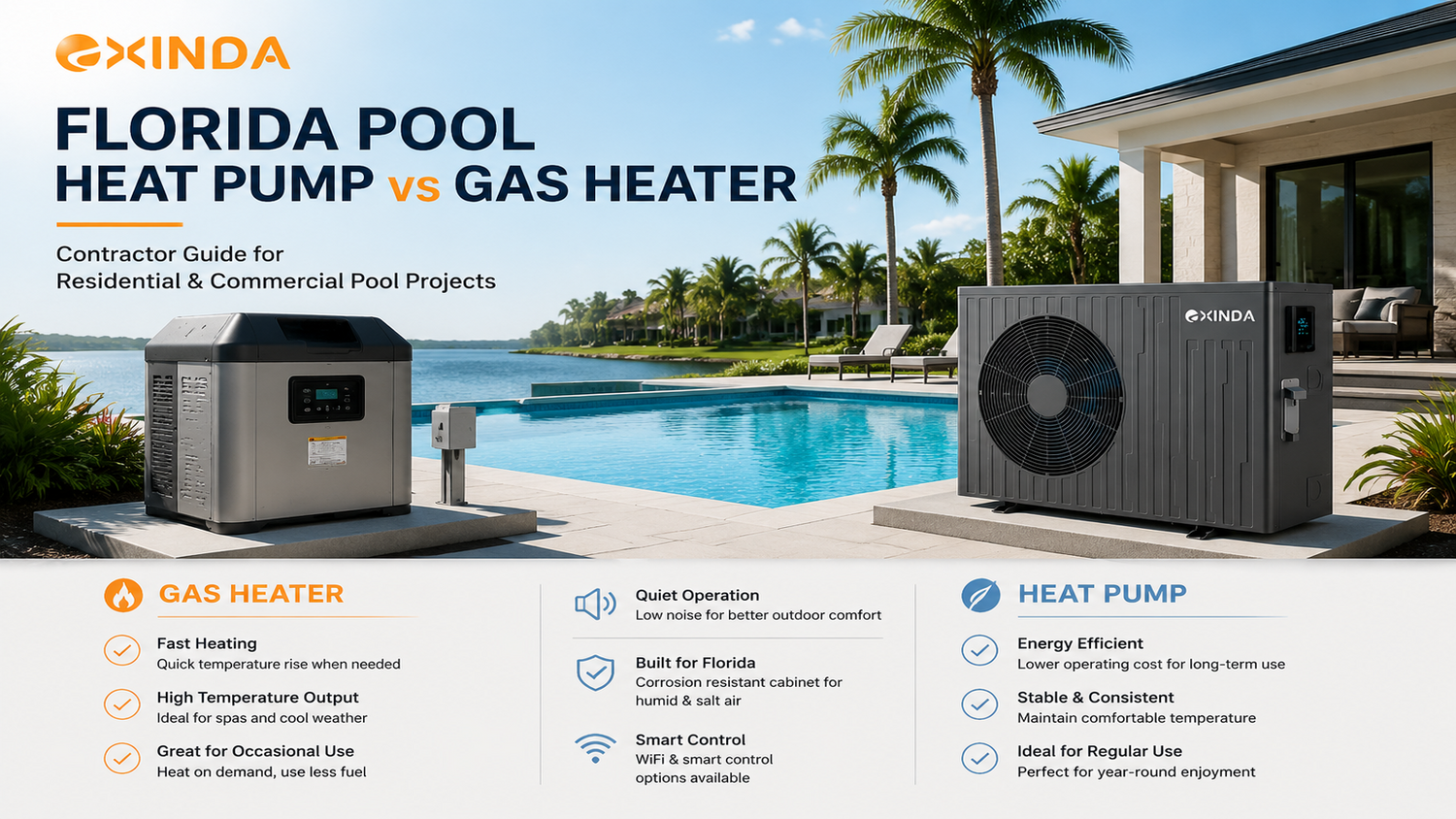
Florida Pool Heat Pump vs Gas Heater selection is a key decision for pool contractors, installers, and distributors working on residential and commercial pool projects.
Florida is one of the most active swimming pool markets in North America. However, selecting the right heating system requires more than comparing equipment prices.
Contractors need to consider:
- How often the pool is used
- Required heating speed
- Pool size
- Operating cost
- Installation conditions
- Long-term maintenance requirements
Both heat pumps and gas heaters have their place in Florida pool applications. The right choice depends on the project requirements.
1. Understanding Pool Heat Pump and Gas Heater Technology
Before selecting equipment, contractors should understand the difference between the two technologies.
| Technology | How It Works | Main Advantage |
|---|---|---|
| Pool Heat Pump | Transfers heat from outdoor air into pool water | Efficient long-term operation |
| Gas Heater | Burns natural gas or propane to generate heat | Fast temperature increase |
A heat pump uses ambient air energy, while a gas heater creates heat through combustion.
This difference affects:
- Operating cost
- Heating speed
- Installation requirements
- Best application scenarios
2. Pool Heat Pump vs Gas Heater: Key Performance Comparison
For Florida projects, the main decision factors are usually:
- Heating speed
- Energy efficiency
- Operating cost
- Usage pattern
Comparison Table
| Factor | Pool Heat Pump | Gas Heater |
|---|---|---|
| Best application | Regular pool usage | Occasional fast heating |
| Heating method | Air-source heat transfer | Fuel combustion |
| Operating cost | Lower for continuous operation | Higher during operation |
| Heating speed | Gradual temperature increase | Fast temperature increase |
| Best climate | Warm climates like Florida | Any climate |
| Maintenance focus | Airflow, water flow, outdoor condition | Burner, gas system, ventilation |
For Florida residential pools that are used frequently, heat pumps are often considered because the climate provides favorable conditions for air-source heating.
3. When Should Florida Contractors Recommend a Pool Heat Pump?
A Florida Pool Heat Pump is usually suitable for customers who want:
- Regular swimming throughout the year
- Lower operating costs
- Stable temperature maintenance
- Quiet outdoor operation
Typical applications:
| Application | Recommended Solution |
|---|---|
| Daily residential pool use | Pool Heat Pump |
| Vacation rental pool | Pool Heat Pump |
| Community pool | Pool Heat Pump |
| Resort pool | Pool Heat Pump |
| Occasional weekend pool use | Gas Heater may be considered |
The key question is:
Does the customer want to maintain pool temperature, or heat the pool quickly on demand?
4. When Is a Gas Heater a Better Choice?
Gas heaters still have advantages in specific applications.
They are often considered when customers require:
| Requirement | Why Gas Heater Fits |
|---|---|
| Fast heating | Rapid temperature increase |
| Occasional usage | Heat only when needed |
| Spa heating | High temperature demand |
| Events | Quick preparation before use |
For example:
A vacation home owner who only uses the pool a few weekends per year may value fast heating more than daily efficiency.
5. Operating Cost Considerations in Florida
For contractors, customers often ask:
“Which system costs less to operate?”
The answer depends on usage frequency.
Long-Term Operating Logic
| Usage Pattern | Recommended Consideration |
|---|---|
| Swimming several times per week | Heat Pump advantage |
| Maintaining temperature continuously | Heat Pump advantage |
| Heating only occasionally | Gas may be suitable |
| Fast spa heating | Gas advantage |
The reason:
A heat pump transfers available heat from surrounding air, while a gas heater consumes fuel to create heat.
Florida’s warm climate allows heat pumps to operate efficiently for much of the year.
6. Pool Size and Capacity Selection for Florida Projects
Regardless of heating technology, correct sizing is critical.
For EXINDA North America pool heat pump projects, contractors select from:
| Model | Suggested Application |
|---|---|
| 65,000 BTU | Residential pools |
| 96,000 BTU | Larger residential pools |
| 121,000 BTU | Large residential and commercial pools |
| 150,000 BTU | Commercial and high-demand pools |
Suggested pool volume with cover:
| Model | Pool Volume |
|---|---|
| 65,000 BTU | 10,000–17,000 gallons |
| 96,000 BTU | 15,000–24,000 gallons |
| 121,000 BTU | 21,000–32,000 gallons |
| 150,000 BTU | 26,000–42,000 gallons |
For contractors, correct sizing helps avoid:
- Long heating times
- Customer complaints
- Excessive operating hours
7. Florida Environment: Why Equipment Design Matters
Florida creates specific challenges for outdoor pool equipment.
Common conditions include:
- High humidity
- UV exposure
- Saltwater pools
- Coastal environments
For heat pump applications, contractors should evaluate:
| Component | Why It Matters |
|---|---|
| Heat exchanger | Direct contact with pool water |
| Outdoor casing | Protection from environment |
| Compressor | Long-term reliability |
| Airflow design | Heat transfer performance |
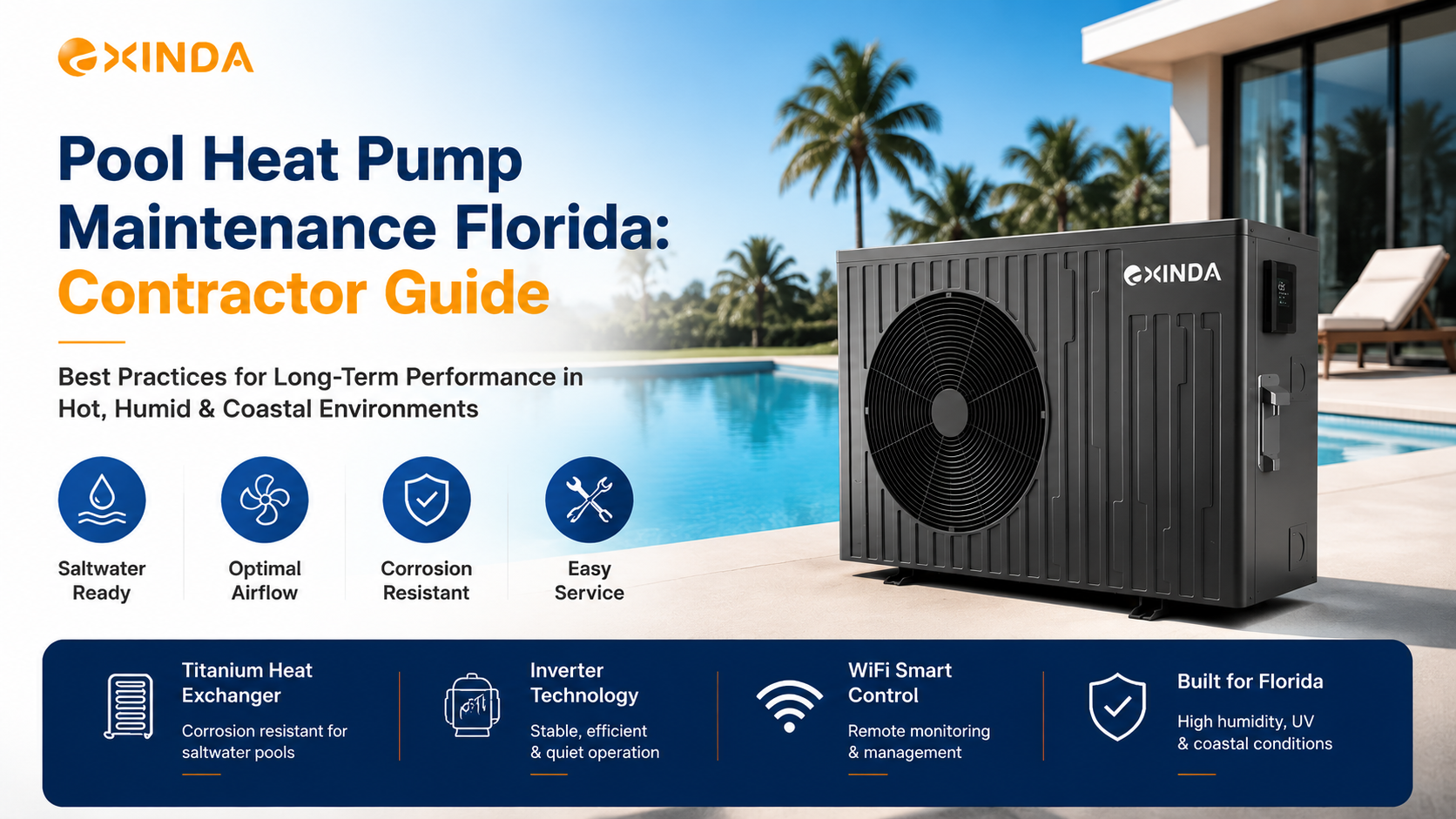
EXINDA pool heat pumps use titanium heat exchangers designed for corrosion resistance in pool applications, including freshwater and saltwater environments.
The units also feature corrosion-resistant casing designed for outdoor applications with UV and environmental exposure.
8. Installation Comparison for Contractors
Installation requirements are different between heat pumps and gas heaters.
| Installation Factor | Pool Heat Pump | Gas Heater |
|---|---|---|
| Electrical connection | Required | Required |
| Gas line | Not required | Required |
| Ventilation | Not required | Required |
| Outdoor airflow | Important | Less critical |
| Equipment location | Requires airflow space | Requires gas safety clearance |
For EXINDA North America pool heat pump models:
| Model | Water Connection |
|---|---|
| 65,000 BTU | 1.5 inch |
| 96,000 BTU | 2 inch |
| 121,000 BTU | 2 inch |
| 150,000 BTU | 2 inch |
9. Why Inverter Pool Heat Pumps Are Becoming More Popular
Modern pool projects increasingly require:
- Lower operating cost
- Stable temperature control
- Quiet operation
Inverter technology allows the system to adjust output based on actual demand.
EXINDA inverter pool heat pumps use twin-rotary inverter compressors designed for stable operation and efficient performance.
Benefits:
| Feature | Contractor Benefit |
|---|---|
| Variable output | Matches heating demand |
| Inverter compressor | Stable operation |
| Low noise | Better residential experience |
10. Choosing Between Florida Pool Heat Pump and Gas Heater
For contractors, the selection process can be simplified:
| Customer Requirement | Recommended Solution |
|---|---|
| Wants lowest long-term operating cost | Pool Heat Pump |
| Uses pool frequently | Pool Heat Pump |
| Wants quick heating | Gas Heater |
| Has spa with high temperature demand | Gas Heater |
| Wants year-round pool comfort | Pool Heat Pump |
| Commercial continuous operation | Pool Heat Pump |
The best solution depends on the customer's usage pattern.
Why EXINDA Pool Heat Pumps Fit Florida Applications
EXINDA provides inverter swimming pool heat pump solutions designed for residential and commercial projects.
North America models include:
- 65,000 BTU
- 96,000 BTU
- 121,000 BTU
- 150,000 BTU
Key features include:
- Twin-rotary inverter compressor
- Titanium heat exchanger
- Corrosion-resistant casing
- Heat and cool capability on selected models
- Smart WiFi control options
For Florida pool contractors, choosing the right heating system requires balancing:
- Performance
- Operating cost
- Installation requirements
- Long-term reliability
FAQ
1. Is a pool heat pump better than a gas heater in Florida?
It depends on the application. Pool heat pumps are generally suitable for regular pool use, while gas heaters are preferred when fast heating is required.
2. Why are pool heat pumps popular in Florida?
Florida’s warm climate allows heat pumps to use ambient air efficiently, making them suitable for many residential and commercial applications.
3. When should contractors recommend gas heaters?
Gas heaters are suitable for customers who need rapid heating, occasional use, or high-temperature spa applications.
4. What pool heat pump sizes does EXINDA offer in North America?
EXINDA offers:
- 65,000 BTU
- 96,000 BTU
- 121,000 BTU
- 150,000 BTU
pool heat pump models.
5. Are pool heat pumps suitable for saltwater pools?
Yes. Material selection is important. EXINDA uses titanium heat exchangers designed for corrosion-resistant pool applications.
6. What should contractors consider before recommending a pool heating system?
Contractors should evaluate:
- Pool size
- Usage frequency
- Required heating speed
- Installation conditions
- Long-term operating expectations
Contact: info@exindagroup.com