Solving Ceiling Plenum Constraints in a Manhattan Multi-Family Retrofit Using EXINDA 130 CFM Ultra-Slim ERV System
PROJECT AT A GLANCE
A multi-family residential apartment building located in Manhattan, New York, USA required a full ventilation system upgrade to improve indoor air quality and meet current energy and mechanical code requirements while operating under severe architectural constraints.
The project consisted of 110,000 SF of total building area and 492 residential units, requiring a decentralized ventilation strategy to ensure balanced and consistent air exchange across all living spaces.
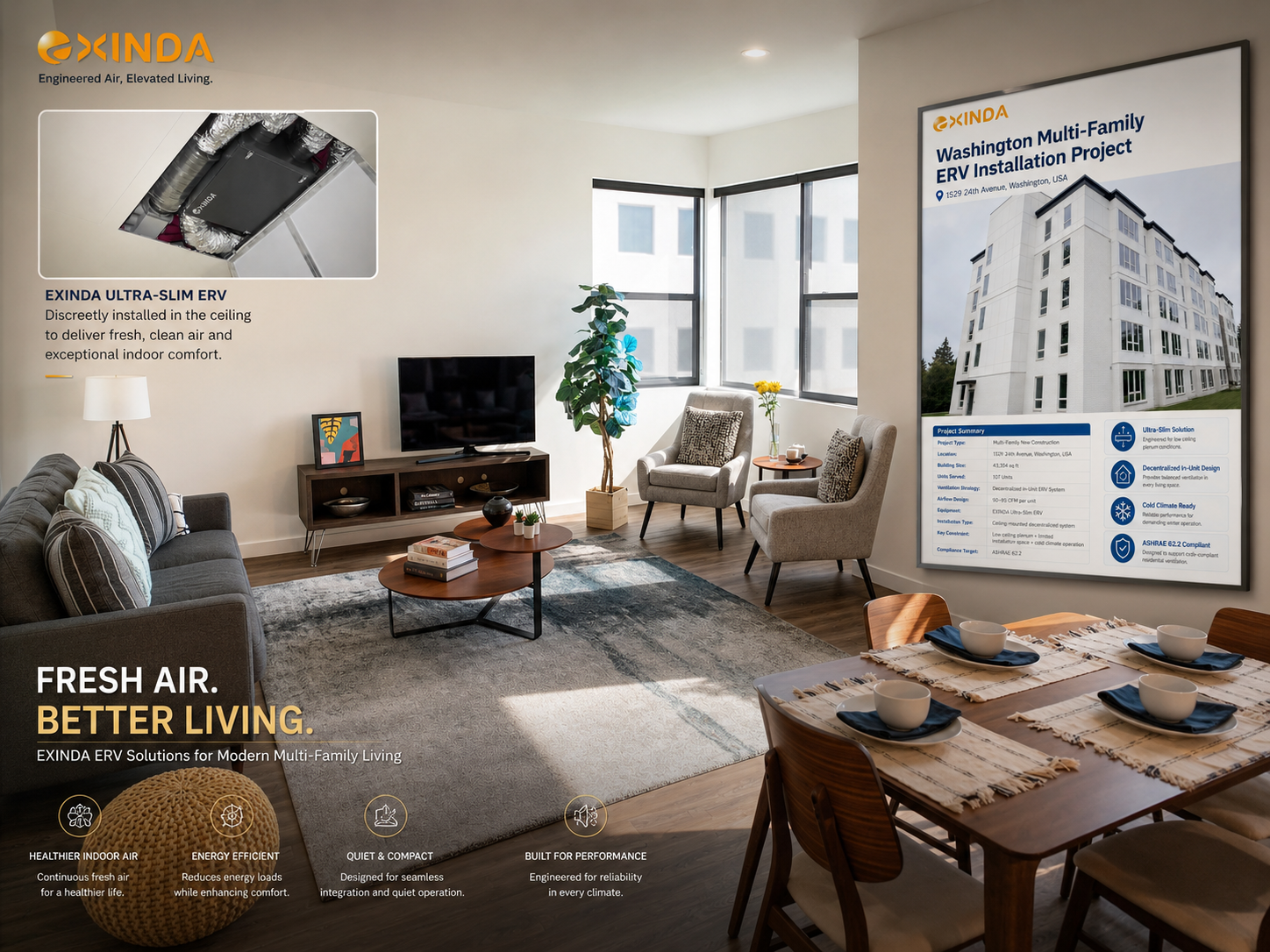
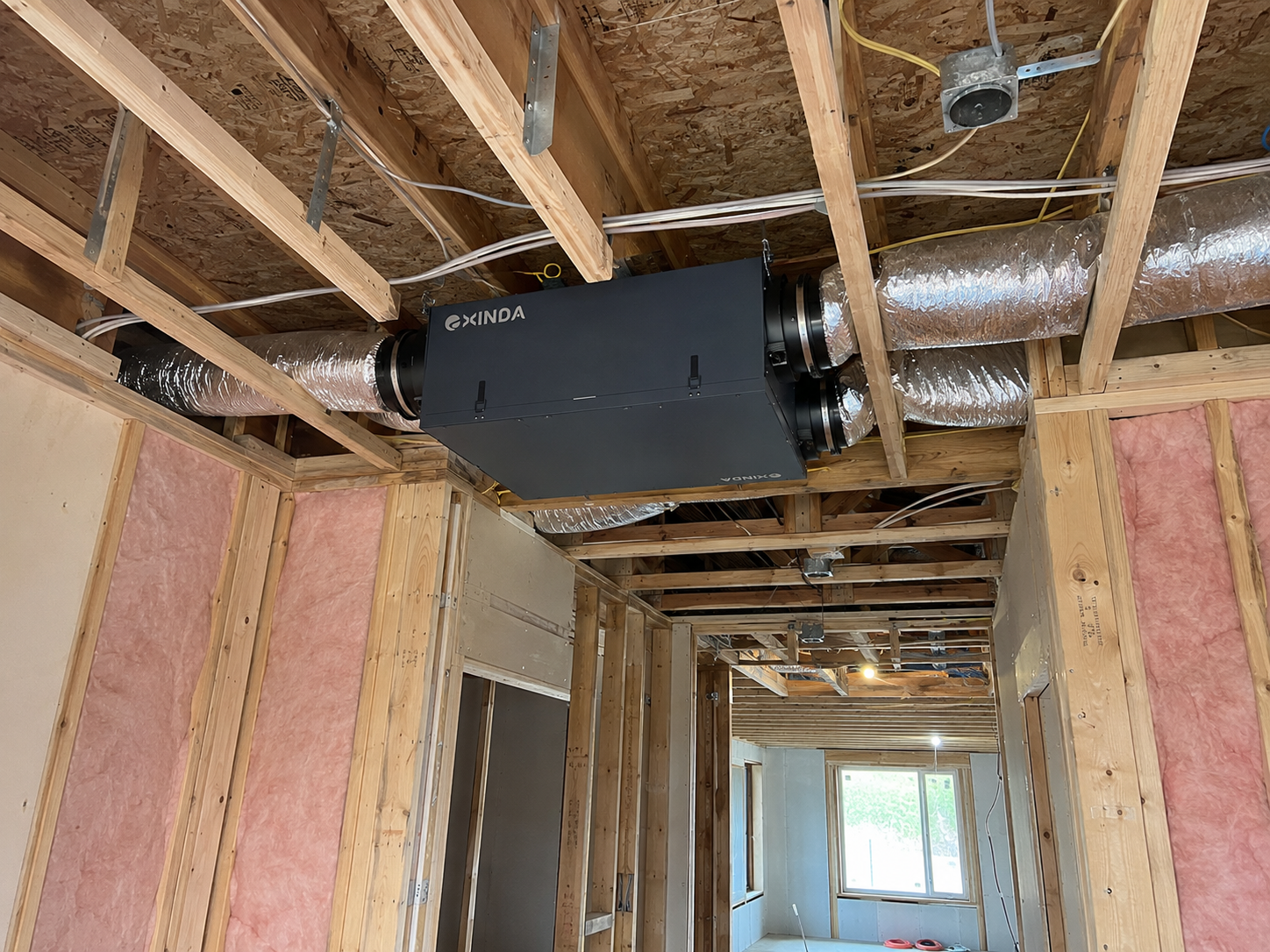
EXINDA 130 CFM ultra-slim energy recovery ventilator (ERV) units were selected to support in-unit decentralized installation within existing ceiling cavities without structural modification.
Project Summary
| Category | Specification |
|---|---|
| Project Type | Multi-Family Residential Retrofit |
| Location | Manhattan, NY, USA |
| Building Size | 110,000 SF |
| Units Served | 492 Units |
| Ventilation Strategy | Decentralized In-Unit ERV System |
| Airflow Design | 130 CFM per unit |
| Equipment | EXINDA Ultra-Slim ERV |
| Installation Type | Ceiling-mounted decentralized in-unit system |
| Key Constraint | Low ceiling plenum + retrofit limitation |
| Compliance Target | ASHRAE 62.2 |
DESIGN CHALLENGE
Engineering Constraint
The existing building presented significant retrofit limitations, primarily driven by extremely shallow ceiling plenum conditions and complex structural obstructions that prevented the use of conventional ducted ventilation systems.
Traditional ERV configurations would have required ceiling height reduction, major architectural rework, and extended construction downtime, making them unsuitable for phased residential retrofit execution.
Engineered specifically to satisfy the balanced ventilation ventilation rate mandates of ASHRAE 62.2 and NYCECC performance path for high-density multi-family buildings.
Eliminates common multi-family drop-ceiling condensation risks and installer mismatch issues via an integrated auto-balancing ECM system that requires no complex condensate drain piping.
COMPETITOR DESIGN CONTEXT
Standard multi-family ventilation designs in similar Manhattan retrofit projects typically rely on centralized ERV systems or ceiling-concealed ducted units.
These systems often require larger installation depth, extensive duct routing, and manual airflow balancing during commissioning, which increases labor intensity and reduces retrofit feasibility in occupied buildings.
ENGINEERING SOLUTION
The EXINDA solution implemented a decentralized in-unit ventilation architecture, where each residential unit operates an independent energy recovery ventilation system.
This approach removed the dependency on central duct risers and significantly reduced installation complexity in confined ceiling conditions.
Key System Characteristics
- Ultra-slim 9.7-inch chassis designed for shallow ceiling plenums
- 130 CFM optimized airflow per residential unit
- Integrated auto-balancing ECM control system
- Decentralized in-unit installation strategy
- High-efficiency energy recovery core for heat and moisture transfer
TECHNICAL COMPARISON
| Parameter | Conventional ERV System | EXINDA 130 CFM System |
|---|---|---|
| Installation Depth | 12–15 inches | 9.7 inches |
| Airflow Balancing | Manual TAB required | Auto-balancing ECM system |
| System Architecture | Centralized duct system | Decentralized in-unit system |
| Ceiling Modification | Required | Not required |
| Commissioning Effort | High | Reduced |
| Retrofit Compatibility | Limited | High |
INSTALLATION OUTCOME
Structural Impact
The ultra-slim form factor enabled full system deployment without modifying existing ceiling structures, preserving architectural integrity throughout all 492 residential units.
Construction Efficiency
The auto-balancing airflow control system reduced field commissioning and testing requirements, significantly improving installation workflow efficiency.
Ventilation Performance
Stable and balanced ventilation was achieved across all residential units, supporting compliance with ASHRAE 62.2 indoor air quality requirements.
Retrofit Feasibility
The decentralized system design eliminated dependence on centralized duct infrastructure, making it suitable for high-density urban retrofit conditions.
ENGINEERING INSIGHT
In high-density urban retrofit projects, ceiling plenum constraints are often a more critical design limitation than airflow capacity itself.
Decentralized ultra-slim ERV systems enable compliance-driven ventilation upgrades without requiring structural modification, making them increasingly suitable for large-scale multi-family modernization projects.
WHY EXINDA
EXINDA ERV systems are increasingly selected for North American multi-family retrofit applications due to their ability to:
- Solve severe ceiling plenum constraints in existing buildings
- Maintain ASHRAE 62.2 compliant ventilation performance
- Reduce commissioning and balancing labor requirements
- Enable scalable decentralized ventilation design
- Improve retrofit feasibility in dense urban housing stock
CONCLUSION
This Manhattan multi-family retrofit demonstrates that ultra-slim decentralized ERV systems can effectively resolve ventilation challenges in buildings with extreme spatial limitations.
By eliminating the need for ceiling modification while maintaining stable airflow performance, EXINDA provides a scalable and code-compliant solution for modern urban residential retrofits.