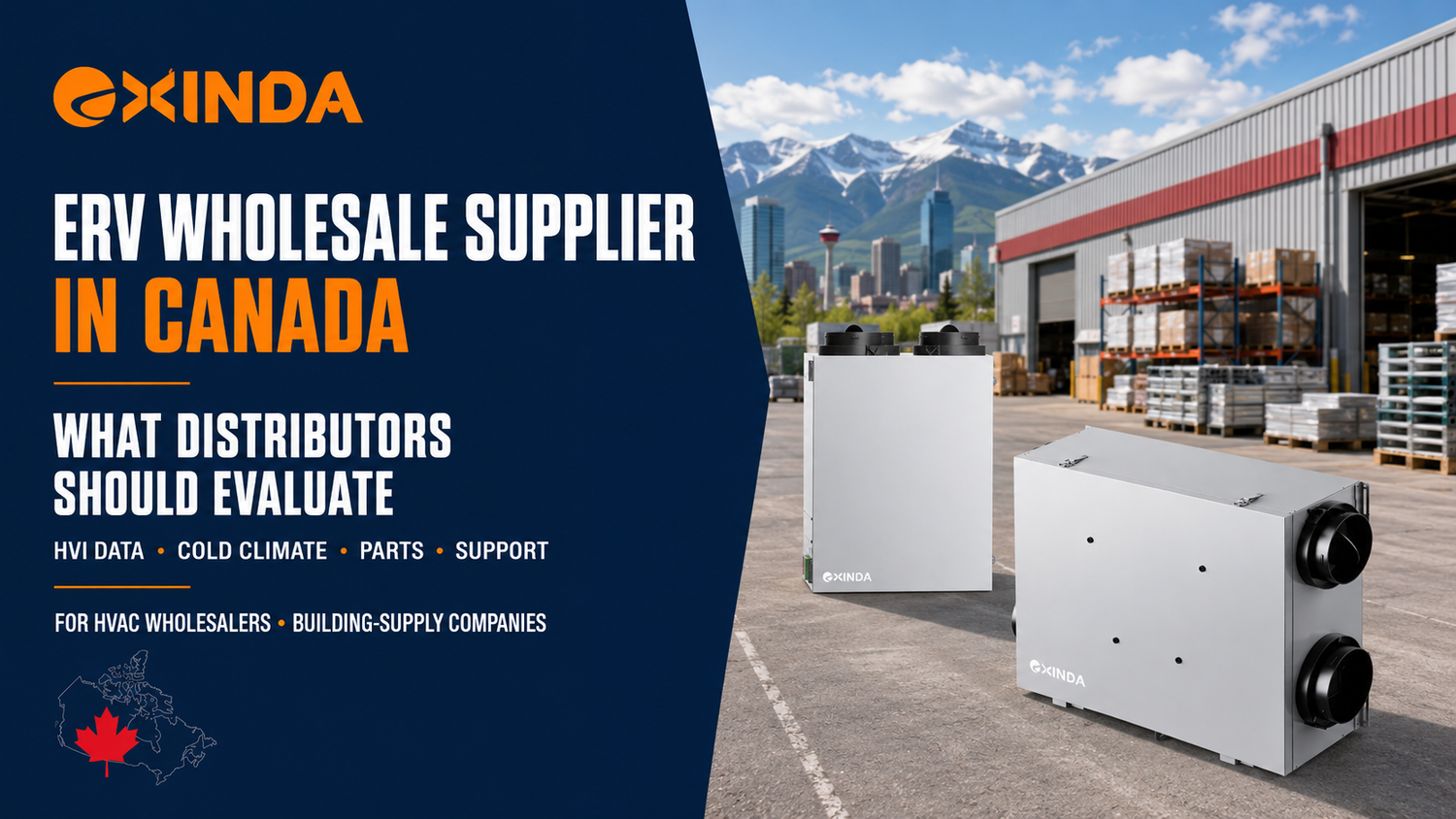
ERV wholesale supplier in Canada selection should be based on verified performance, cold-climate suitability, product-line coverage and long-term channel support—not unit price alone.
For Canadian HVAC wholesalers, building-supply companies and regional distributors, adding a new energy recovery ventilator brand is a strategic decision. The equipment must satisfy project specifications, support different residential applications and remain serviceable after installation.
A suitable supplier should provide more than an ERV catalogue. Canadian distributors need model-specific HVI data, clear certification documentation, dependable spare-parts support, installation materials, training and a commercial structure that protects the channel.
This guide explains what Canadian distributors should evaluate before adding a new ERV manufacturer to their product range.
What Should an ERV Wholesale Supplier in Canada Provide?
A qualified supplier should be able to provide evidence in five main areas:
| Evaluation area | What distributors should request |
|---|---|
| Canadian market readiness | Models suitable for Canadian voltage, climate and residential applications |
| Verified performance | Model-specific airflow, SRE, power and cold-weather data |
| Product-line coverage | Multiple airflow ranges and installation configurations |
| After-sales support | Filters, motors, controllers, cores and other service parts |
| Channel support | Samples, training, technical files, marketing materials and territory discussions |
The objective is not simply to find a factory capable of producing an ERV. It is to find a manufacturer capable of helping the distributor sell, specify and support the equipment in Canada.
1. Is the ERV Model Listed in the HVI Directory?
One of the first checks should be whether the proposed model appears in the Home Ventilating Institute Certified Products Directory.
HVI listings allow distributors, builders and mechanical consultants to review model-specific performance under recognized test conditions. Depending on the product listing, this may include:
- Net supply airflow
- Sensible Recovery Efficiency at 0°C
- Cold-weather performance
- Apparent Sensible Effectiveness
- Power consumption
- Fan efficacy
- Performance at different external static pressures
The HVI HRV/ERV directory reports certified performance by model. Therefore, a general statement such as “our ERVs are HVI certified” is not sufficient.
The distributor should confirm:
- The exact model number appears in the directory.
- The model offered matches the listed construction and airflow configuration.
- The quoted performance corresponds to the published test condition.
- The manufacturer can supply the current HVI listing and technical submittal.
HVI certification should not be confused with electrical safety certification or provincial code compliance. Each requirement should be checked separately for the specific model and application.
2. Does the Supplier Provide SRE at Canadian Test Conditions?
Efficiency percentages can be misleading when the rated condition is not stated.
For Canadian ERV evaluation, distributors should ask for Sensible Recovery Efficiency, or SRE, at the applicable airflow and outdoor temperature. A claim such as “up to 85% efficiency” has limited purchasing value unless the supplier identifies:
- Outdoor test temperature
- Indoor test condition
- Net airflow
- External static pressure
- Fan power
- Defrost status
- Model number
HVI reports SRE at 0°C as part of its certification data. Selected products may also have performance reported under colder conditions.
For example, when a BC project requests 80% or higher SRE at 0°C, the distributor should verify that the selected model—not merely another unit in the same product family—meets that performance level at the required airflow.
EXINDA offers selected Canadian ERV models with 80%+ SRE at 0°C, subject to the published model and rated airflow. Distributors should use the applicable HVI data rather than applying one efficiency figure to the entire range.
3. Can the ERV Operate Reliably in Cold Canadian Conditions?
A Canadian ERV needs more than a low-temperature statement on a brochure. The supplier should explain how the unit behaves when outdoor temperature drops below freezing.
Important questions include:
- What is the stated minimum operating temperature?
- What defrost strategy is used?
- Does defrost stop or reduce supply airflow?
- How does defrost affect building pressure?
- Is a condensate drain required?
- How is frost accumulation controlled?
- What happens when an outdoor intake is blocked by snow or ice?
- Are low-temperature performance data available?
- Can the controller report a fault or defrost condition?
Cold-climate operation is especially important in Alberta, Saskatchewan, Manitoba and colder inland regions. It is also relevant in British Columbia’s Interior and northern communities.
EXINDA Canadian residential ERVs include selected models designed for operation down to approximately −25°C, subject to model specifications and correct installation. This operating limit should not be presented as an efficiency rating: it describes the intended operating range, while actual airflow and recovery performance depend on the stated condition and defrost operation.
4. Does the Product Range Cover Real Canadian Projects?
A distributor usually needs more than one ERV.
The catalogue should cover common residential applications, including:
- Apartments and condominiums
- Townhouses
- Detached homes
- Secondary suites
- Modular homes
- Multifamily residential projects
- Residential renovation
- Light-commercial applications where appropriate
EXINDA’s Canadian residential range covers approximately 90–170 CFM, depending on the selected model and operating point.
Available configurations include selected:
- Top-port ERVs
- Side-port ERVs
- Compact installation formats
- Field-adjustable airflow models
- Wall-controller options
- Optional timer and boost-control solutions
- MERV 13 filtration configurations
A broader range allows the distributor to respond to different mechanical layouts without introducing several unrelated brands.
However, selection should always be based on the required airflow at the project’s external static pressure—not only the maximum free-air CFM printed on the catalogue.
5. Is Airflow Published at External Static Pressure?
One of the most important technical checks is airflow at the required external static pressure.
An ERV may produce its advertised maximum airflow under a low-resistance test condition but deliver substantially less air after it is connected to:
- Supply and exhaust ducts
- Exterior hoods
- Balancing dampers
- Grilles and diffusers
- Higher-efficiency filters
- Long or restrictive duct runs
Canadian distributors should request performance curves or airflow tables showing CFM at multiple static-pressure points.
Questions to ask include:
- What airflow is available at 0.2, 0.3 and 0.4 in. w.g.?
- Is the airflow factory-set or field-adjustable?
- Can the supply and exhaust sides be balanced independently?
- What is the maximum recommended system resistance?
- Does the HVI-listed airflow match the project selection point?
This information helps contractors avoid under-ventilation and reduces the risk of selecting an ERV solely from a nominal CFM value.
6. How Does MERV 13 Affect ERV Performance?
MERV 13 filtration is increasingly considered for projects affected by wildfire smoke, fine particles and outdoor-air quality concerns.
However, MERV 13 is not simply a marketing upgrade. A higher-efficiency filter normally creates more pressure drop than a standard filter, especially as dust accumulates.
The distributor should ask:
- Is MERV 13 a factory-designed option?
- Was airflow evaluated with the proposed filter?
- Does the filter require a different fan setting?
- What is the replacement size and part number?
- Is the filter readily available?
- How frequently should it be inspected or replaced?
- What airflow remains at the project’s external static pressure?
EXINDA can provide MERV 13 options for applicable models and projects. Final airflow must be checked using the selected filter, fan setting and duct-system resistance.
Health Canada also notes that ERV filters require regular cleaning or replacement and that inadequate maintenance can affect ventilation performance. More efficient filtration should therefore be paired with clear maintenance instructions and replacement-filter availability. Health Canada ventilation guidance
7. Are Controls Suitable for Canadian Contractors?
Controls affect both occupant satisfaction and contractor call-backs.
A practical residential ERV control package may include:
- Continuous low-speed ventilation
- Medium and high-speed operation
- Intermittent or automatic modes
- Humidity-based control
- Timed boost
- Bathroom override
- Dry-contact input
- Fault indication
- Filter-maintenance reminder
- Building-automation communication where applicable
Distributors should confirm which controls are included in the base price and which are optional.
For example, the following should be listed separately:
- Basic wall controller
- 20/40/60-minute timer
- Remote boost switch
- Humidity controller
- CO₂ or demand-control sensor
- Modbus interface
- Replacement controller
The manufacturer should also provide wiring diagrams and a clear sequence of operation. A long feature list is not useful if the contractor cannot understand how to connect and commission the controls.
8. What Installation and Service Documentation Is Available?
Before stocking a new brand, distributors should review the same documents their contractors will receive.
The supplier should provide:
- Product catalogue
- Technical submittal
- Installation manual
- User manual
- Wiring diagram
- Control sequence
- Airflow tables or fan curves
- Balancing instructions
- Filter replacement guide
- Troubleshooting guide
- Exploded-parts diagram
- Warranty procedure
- Product photographs and dimensional drawings
For project business, mechanical consultants may also request:
- Model-specific schedules
- HVI data
- Electrical information
- Sound data
- External static-pressure performance
- Guide specifications
- Revit or BIM files where available
- Compliance statements
- Shop-drawing support
Incomplete documentation creates work for the distributor and reduces the probability that engineers will accept the brand.
9. Are Spare Parts Included in the Distribution Plan?
An ERV may remain installed for many years. The distributor therefore needs a realistic service-parts strategy.
Priority spare parts may include:
- Supply and exhaust motors
- Control boards
- Wall controllers
- Temperature and humidity sensors
- Dampers and actuators
- Filter sets
- Energy-recovery cores
- Wiring harnesses
- Drain components
- Access-door hardware
Before placing a container or stocking order, the distributor should agree on:
- Recommended free spare-parts allocation
- Additional spare-parts pricing
- Warranty replacement process
- Parts identification and labelling
- Diagnostic responsibility
- Expected parts availability
- Training for first-line troubleshooting
A supplier offering a low equipment price without a parts plan may create higher long-term costs for the distributor.
10. What Support Is Available for Samples and Initial Orders?
A sample programme should allow the distributor to evaluate more than appearance.
The initial unit can be used for:
- Contractor demonstrations
- Internal technical training
- Airflow and control evaluation
- Showroom presentation
- Installation review
- Consultant meetings
- Builder product approval
- Local marketing photography
Before ordering a sample, the distributor should confirm that it represents the same configuration intended for future Canadian orders.
For the first commercial order, the discussion should cover:
- Model mix
- Minimum order quantity
- Container loading
- Controller inclusion
- Optional timers
- Replacement filters
- Spare-parts allocation
- Production lead time
- Packaging
- Freight terms
- Documentation
- Warranty handling
This produces a more accurate landed-cost calculation than comparing factory unit prices alone.
11. Does the Manufacturer Protect the Distributor’s Market Development?
Territory and project protection are important when a distributor invests in:
- Samples
- Inventory
- Training
- Local certification work
- Builder approvals
- Consultant specifications
- Digital marketing
- Trade shows
- Contractor relationships
Distributors should ask whether the manufacturer offers:
- Registered-project protection
- Lead referral
- Regional dealer arrangements
- Sales targets for exclusivity
- Restrictions on direct sales
- Named-account protection
- Annual territory review
- Marketing-development support
Exclusivity should normally be linked to measurable commitments such as inventory, annual sales, local service capability and market investment.
An immediate national exclusivity agreement without sales targets is rarely sustainable for either party.
12. EXINDA Brand or Private-Label ERV?
Canadian distributors may choose between selling the manufacturer’s existing brand and developing a private-label range.
| EXINDA brand distribution | Private-label cooperation |
|---|---|
| Faster market entry | Distributor controls branding |
| Existing product identity | Custom packaging and artwork |
| Lower initial development work | Potential channel differentiation |
| Easier use of existing materials | Requires artwork and approval process |
| Suitable for samples and initial orders | Usually requires higher commitment |
| Manufacturer and distributor share brand building | Distributor assumes more marketing responsibility |
For most new relationships, beginning with the EXINDA brand is the more practical approach. It allows the distributor to evaluate product acceptance, contractor feedback and service requirements before committing to private-label inventory.
OEM or private-label cooperation can be considered after the distributor confirms:
- Target territory
- Model range
- Annual volume
- Certification responsibilities
- Trademark ownership
- Packaging requirements
- Spare-parts branding
- Warranty obligations
- Technical-document ownership
Why Evaluate EXINDA as an ERV Supplier?
EXINDA supports Canadian HVAC distributors, building-supply companies, builders and mechanical contractors with residential ERV products and technical documentation.
Depending on the selected model, the Canadian range includes:
- Approximately 90–170 CFM residential ERVs
- Top-port and side-port configurations
- HVI-listed models
- Selected models with 80%+ SRE at 0°C
- Cold-climate operation down to approximately −25°C
- Field-adjustable airflow
- Wall-controller and timer options
- MERV 13 options for applicable projects
- Technical submittals and installation documentation
- Samples, spare parts and training support
- EXINDA-brand and selected OEM cooperation
Every efficiency, airflow and operating-range claim should be verified against the applicable model’s published data.
ERV Distributor Evaluation Checklist
Before approving a new ERV wholesale supplier in Canada, ask for:
- Exact HVI-listed model numbers
- Model-specific HVI performance data
- SRE at the stated airflow and temperature
- Airflow at the required external static pressure
- Cold-weather and defrost information
- Electrical certification documentation
- Canadian voltage and control compatibility
- Installation and service manuals
- Replacement-filter information
- Spare-parts list and warranty procedure
- Sample policy
- First-order model mix and MOQ
- Production and shipping lead time
- Territory and project-protection terms
- Marketing and training support
- EXINDA-brand versus private-label conditions
If a supplier cannot provide these items before the first order, the distributor may face unnecessary specification, installation and warranty risks later.
Frequently Asked Questions
What is the most important document when evaluating an ERV supplier in Canada?
The most important starting point is the exact model’s HVI listing and technical submittal. These documents help verify airflow, SRE, power and other performance information under stated conditions.
Does HVI certification mean an ERV automatically complies everywhere in Canada?
No. HVI certification provides independently certified performance information. Electrical safety requirements, energy-efficiency obligations, installation rules and building-code requirements must be evaluated separately for the specific province, project and model.
What airflow range should a Canadian ERV distributor stock?
There is no single correct range. Residential demand commonly varies by dwelling size, occupancy, layout and design airflow. A range of approximately 90–170 CFM can cover many apartments, townhouses and houses, but every project should be selected using its ventilation calculation and external static pressure.
Is 80% SRE at 0°C required everywhere in Canada?
No. An 80% SRE level may be a project requirement, high-performance specification or programme criterion, but it should not be presented as a universal Canadian legal minimum. The requirement depends on the project, jurisdiction and applicable programme.
Can MERV 13 be added to every ERV?
Not automatically. The filter size, available fan capacity, cabinet design and additional pressure drop must be checked. Final airflow should be confirmed for the selected model and duct system.
Should a distributor begin with EXINDA branding or private label?
EXINDA branding is generally faster for samples, project evaluation and initial market testing. Private label is better considered after the distributor confirms territory, annual volume, certification responsibilities and long-term inventory plans.
What should be included with the first wholesale ERV order?
The order should identify the model mix, controllers, optional timers, filters, spare parts, documentation, warranty procedure, packaging, loading quantity, freight terms and expected production schedule.
Talk to EXINDA About ERV Distribution in Canada
If you are an HVAC wholesaler, building-supply company, regional distributor or contractor considering a new ERV product line, EXINDA can provide a model-specific evaluation package.