Overview
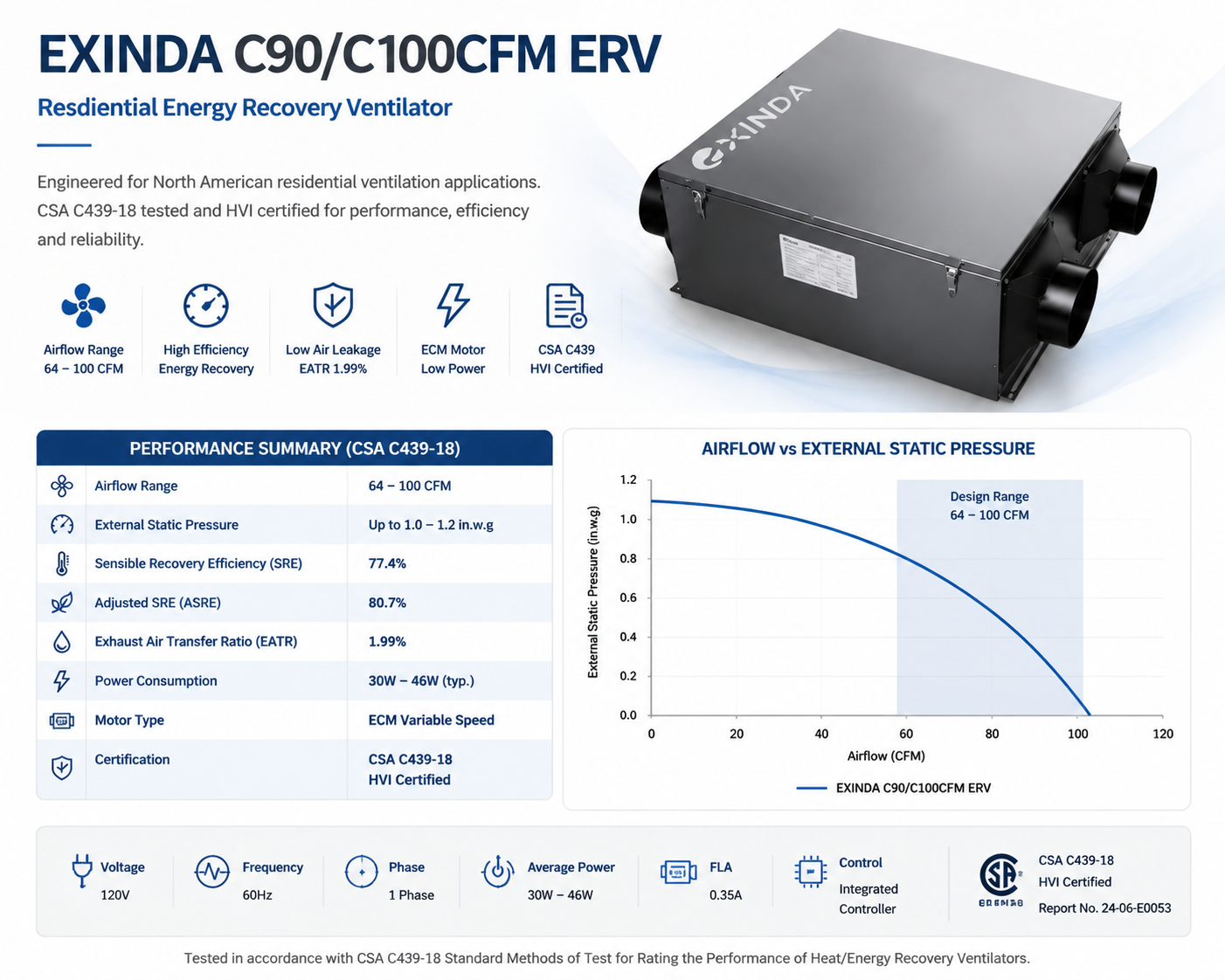
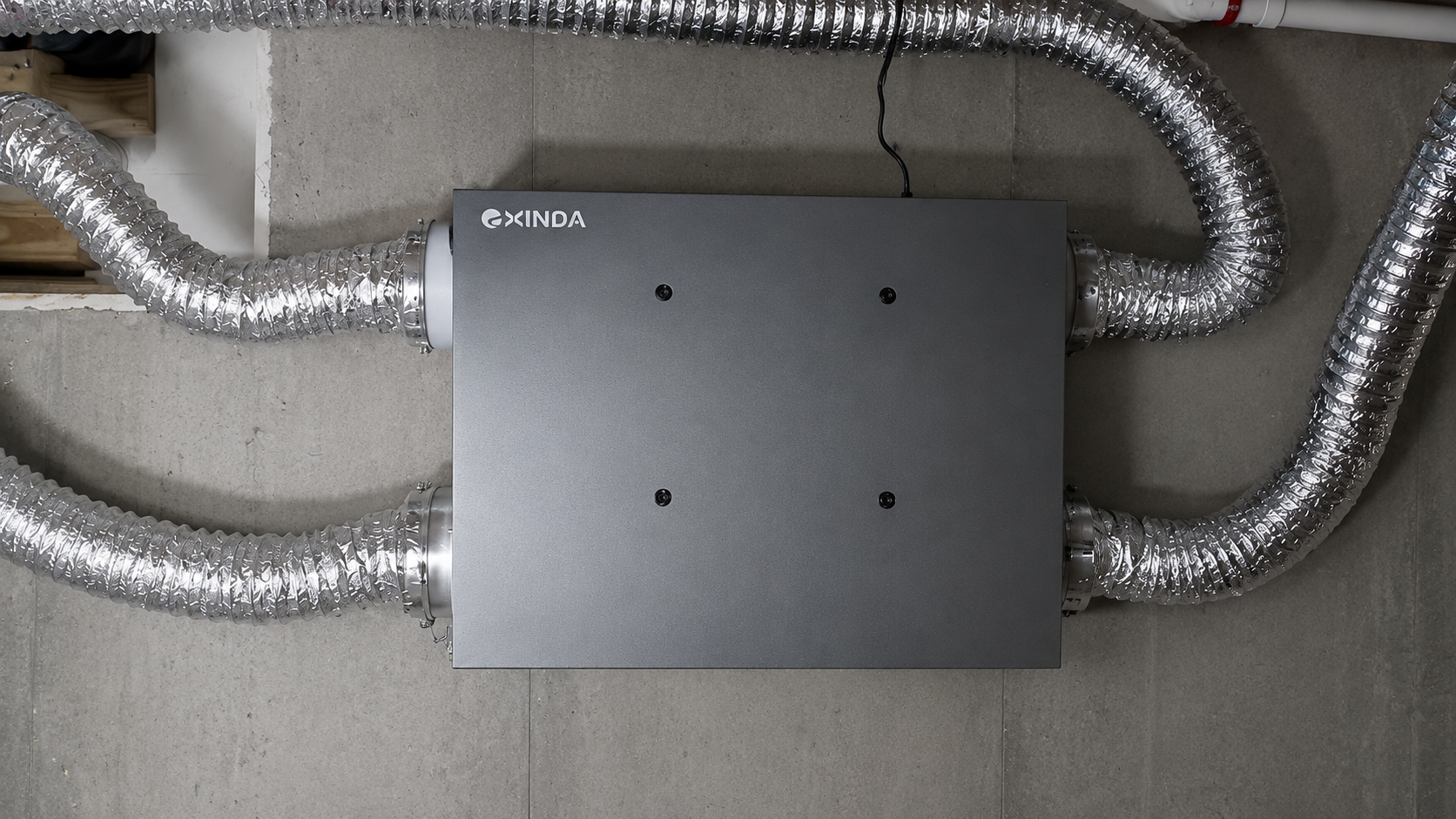
ERV Selection Guide for North America provides an engineering evaluation of EXINDA ICMBCOFF1AYS and Panasonic Intelli-Balance 100. This guide explains HVAC engineering selection methods based on airflow (CFM), static pressure (ESP), and heat recovery efficiency in North American buildings.
1. Problem
ERV Selection Guide for North America explains HVAC engineering selection methods based on airflow (CFM), static pressure (ESP), and heat recovery efficiency in North American buildings.
In energy-efficient housing such as Passive House, LEED-certified buildings, and high-performance residential construction in the United States and Canada, ERV (Energy Recovery Ventilation) systems are required to:
- Provide continuous fresh air supply
- Maintain indoor humidity balance
- Recover thermal energy from exhaust air
- Operate under variable duct static pressure (ESP conditions)
- Comply with ASHRAE 62.2 and CSA ventilation requirements
The core engineering challenge addressed by this ERV Selection Guide for North America is to evaluate how different ERV systems perform under real duct conditions, rather than relying solely on laboratory rated airflow.
2. Answer
From an HVAC engineering perspective, ERV system performance is determined by:
- Airflow stability under external static pressure (CFM vs ESP curve behavior)
- Heat recovery efficiency (Sensible Heat Recovery Efficiency, SRE)
- Moisture transfer capability (latent energy balance)
- Frost protection strategy in cold climates
- Installation flexibility and system balancing capability
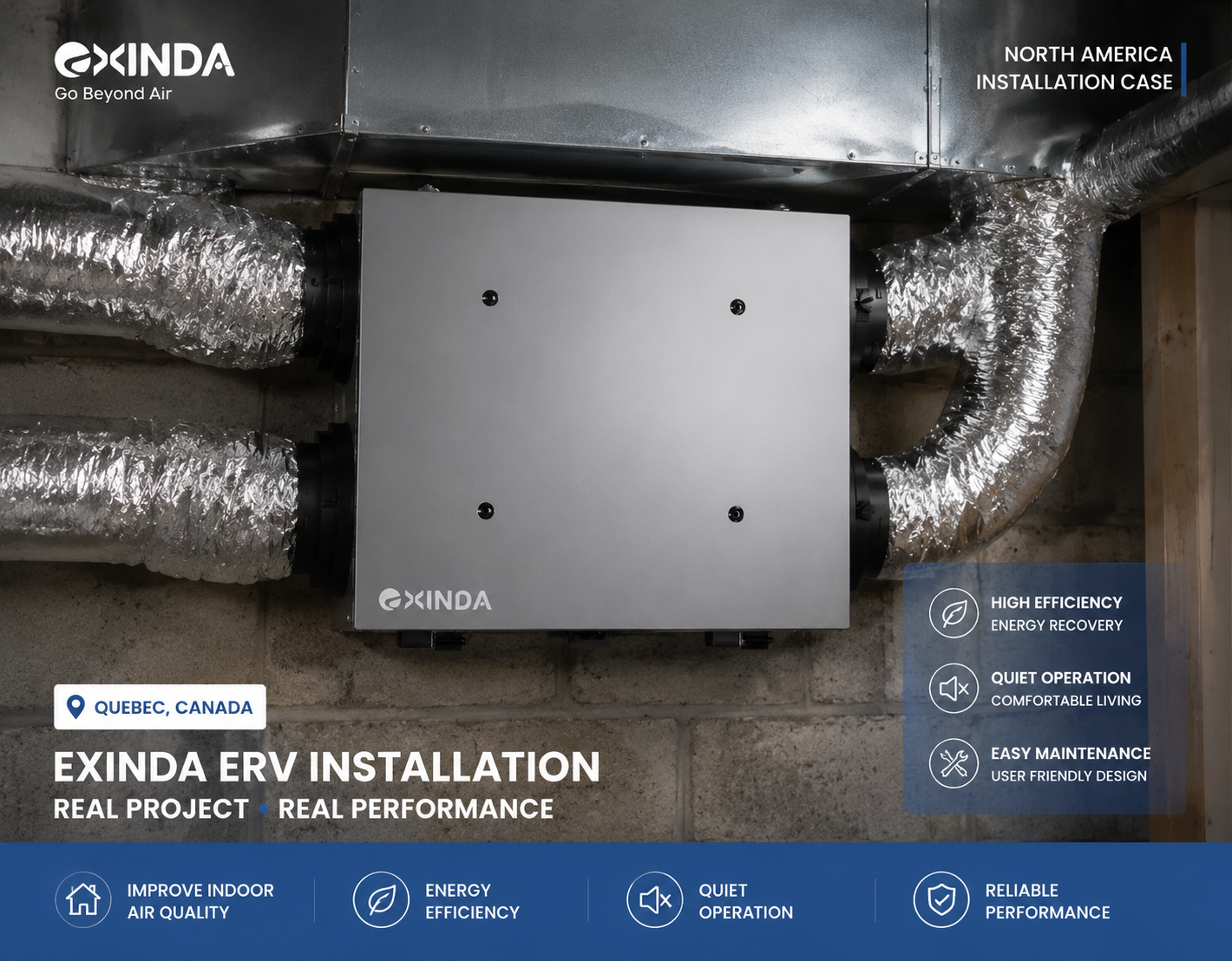
According to the ERV Selection Guide for North America, EXINDA ICMBCOFF1AYS is engineered as a high static pressure residential and light commercial ERV system, while Panasonic Intelli-Balance 100 is designed as a compact residential ventilation unit with fixed airflow balancing logic.
3. Engineering Performance
| Engineering Parameter | EXINDA ICMBCOFF1AYS | Panasonic Intelli-Balance 100 |
|---|---|---|
| Rated Airflow | 130 CFM @ 0.4 in.w.g | 100 CFM stable output |
| Max Airflow Range | Up to 170 CFM | 100 CFM fixed maximum |
| ESP Performance | High static pressure capability | Low to moderate ESP design |
| Airflow Control | HH/H/L multi-speed + manual damper balancing | 7-step supply/exhaust independent balancing |
| Heat Recovery Efficiency | Up to 86% SRE (low airflow condition) | ~83% adjusted SRE |
| Moisture Transfer | Balanced latent performance | Strong summer humidity control (up to ~0.78 moisture transfer) |
| Filter System | Washable MERV 8 + optional MERV 13 | MERV 8 standard + optional MERV 13 |
| Frost Protection | Recirculation defrost (-27.8°C capability) | Air shut-off frost protection (-10°C activation) |
| Installation Strategy | High duct resistance systems | Compact residential ceiling integration |
4. Engineering Explanation (Field Performance Analysis)
4.1 Airflow and Static Pressure Behavior
As emphasized in the ERV Selection Guide for North America, ERV performance in real-world HVAC installations is heavily dictated by duct resistance.
- EXINDA system maintains 130 CFM at 0.4 in.w.g and scales up to 170 CFM
- Panasonic maintains stable 100 CFM under rated conditions
Engineering implication:
- EXINDA is fully optimized for long duct runs, multiple bends, and high-resistance filtration systems, making it an excellent fit for engineering-driven layouts highlighted in this ERV System Selection Guide North America
- Panasonic is optimized for simplified residential duct layouts
4.2 Energy Recovery Performance
Heat recovery core performance determines HVAC load reduction.
- EXINDA achieves up to 86% SRE under low airflow conditions
- Panasonic maintains ~83% adjusted SRE under standard airflow testing
Engineering interpretation:
- EXINDA reduces winter heating load in cold climates by minimizing fresh air reheating demand
- Panasonic provides balanced heat recovery with strong humidity regulation in summer conditions
4.3 Moisture Transfer Behavior
Following the technical standards outlined in the ERV System Selection Guide North America, both systems utilize advanced enthalpy (full heat exchange) core technology.
- EXINDA focuses on balanced humidity control with high efficiency under cold climate load conditions
- Panasonic demonstrates strong moisture transfer efficiency in humid summer environments
4.4 Frost Protection Strategy
Cold climate operation is a critical engineering factor across Canada and the northern United States. This ERV System Selection Guide North America highlights two distinct approaches:
- EXINDA: Recirculation defrost strategy, stable down to -27.8°C
- Panasonic: Airflow shut-off frost protection, activation below -10°C
Engineering implication: EXINDA is designed for extended extreme cold climate operation cycles.
5. Application (North America HVAC Deployment Scenarios)
To optimize your project according to the ERV System Selection Guide North America, consider the following application scenarios:
EXINDA ICMBCOFF1AYS Applications:
- Multi-family residential buildings
- High static pressure duct systems
- Retrofit HVAC ventilation upgrades
- Cold climate residential projects (Canada / Northern US)
- Long duct, high resistance ventilation systems
Panasonic Intelli-Balance 100 Applications:
- Single-family residential homes
- Compact ceiling installation projects
- Standard residential ventilation systems
- Low duct resistance applications
6. Engineering System Interpretation
From an HVAC engineering selection logic perspective, ERV selection is determined by:
- CFM vs building load requirement
- ESP vs duct system resistance
- Heat recovery efficiency vs climate zone
- Frost protection strategy vs winter severity
This ERV Selection Guide North America demonstrates that EXINDA systems are designed for engineering-driven ventilation system selection, while Panasonic systems are designed for residential packaged ventilation deployment.
7. EXINDA Engineering Position
EXINDA is an engineering supplier for North America HVAC ventilation systems, providing:
- ERV system engineering selection support
- Full HVAC submittal documentation (CFM / ESP / efficiency curves)
- Multi-family and residential HVAC project solutions
- Bulider and contractor, distributor engineering support
EXINDA systems are designed for project-based HVAC engineering applications.
8. FAQ
Q1: What is ERV System Selection Guide North America?
It is an HVAC engineering methodology for selecting ERV systems based on CFM, ESP, and heat recovery performance.
Q2: How does ERV reduce energy consumption?
ERV cores recover thermal energy from exhaust air, reducing heating and cooling load required for incoming fresh air.
Example:
Indoor air 25°C, outdoor air 35°C → ERV preconditions incoming air to ~28°C, reducing HVAC cooling demand.
Q3: Why is ERV important in modern buildings?
Modern airtight buildings have high insulation and low air leakage, requiring mechanical ventilation for indoor air quality.
Q4: What is ESP in ERV systems?
External Static Pressure represents duct resistance affecting airflow delivery performance.
Q5: Why is ERV important in North America?
Because airtight buildings require mechanical ventilation under ASHRAE 62.2 standards.
Q6: What is Recirculation Defrost in EXINDA systems?
It is a frost protection method that maintains operation in extreme cold climates by internal air recirculation.
Q7: Why is no condensate drain required in EXINDA ERV?
Moisture is transferred via enthalpy membrane core, reducing liquid condensation under normal operating conditions.
9.Contact
Exinda is a global manufacturer of HVI‑certified Energy Recovery Ventilation (ERV) systems engineered to meet and exceed North American performance standards. For technical support, project evaluation, or engineering documentation requests, please contact EXINDA.
Our team supports bulider, HVAC engineers, contractors, and distributors in North America with product selection and system integration.
Email: info@exindagroup.com
Response time is typically within 24 hours for project and technical inquiries.
10. Summary
ERV Selection Guide for North America defines HVAC engineering principles for selecting residential ERV systems in airtight buildings across the United States and Canada. This guide evaluates EXINDA ICMBCOFF1AYS and Panasonic Intelli-Balance 100 based on airflow (CFM), static pressure (ESP), and heat recovery efficiency for HVAC ventilation system design.