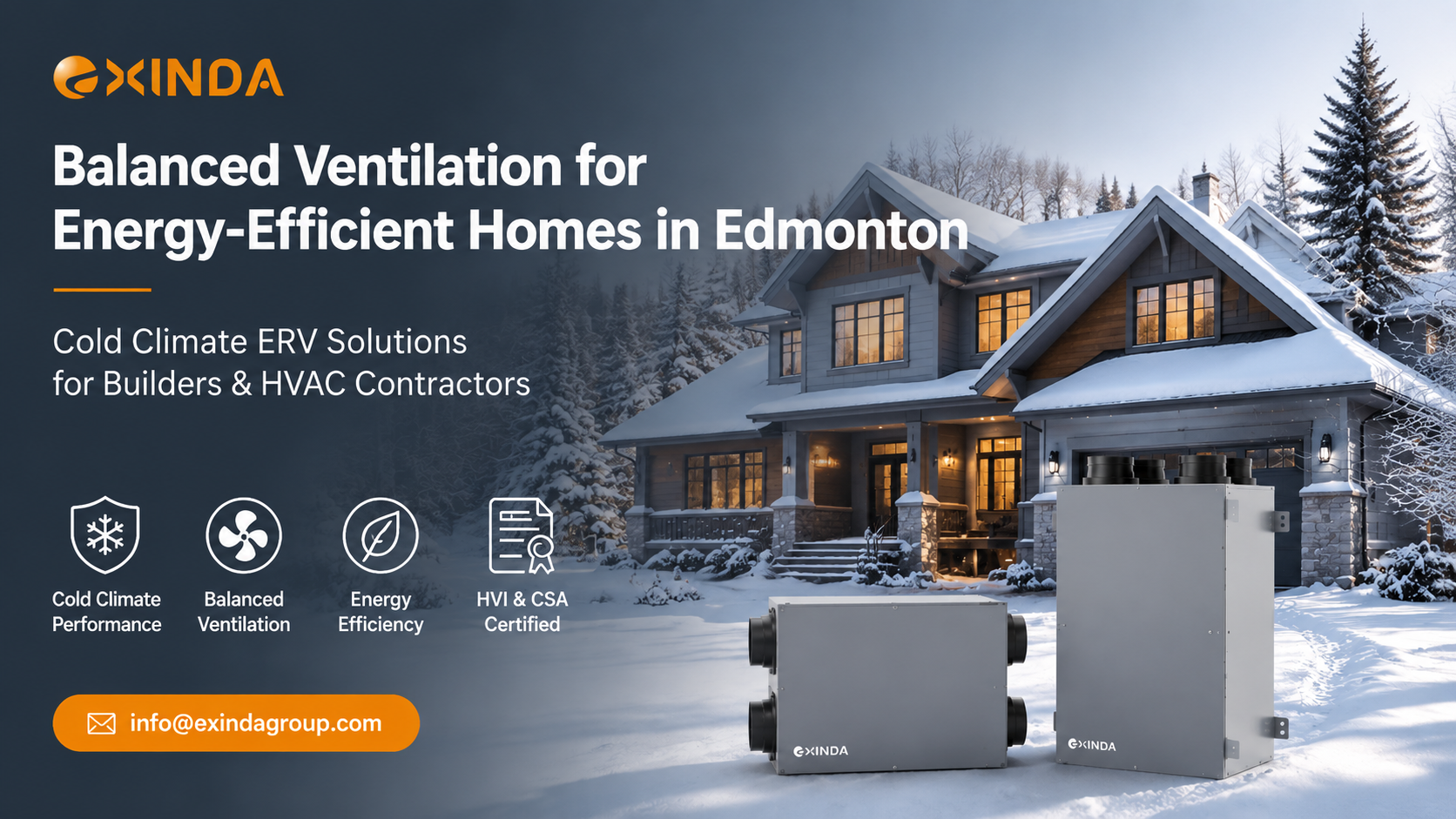
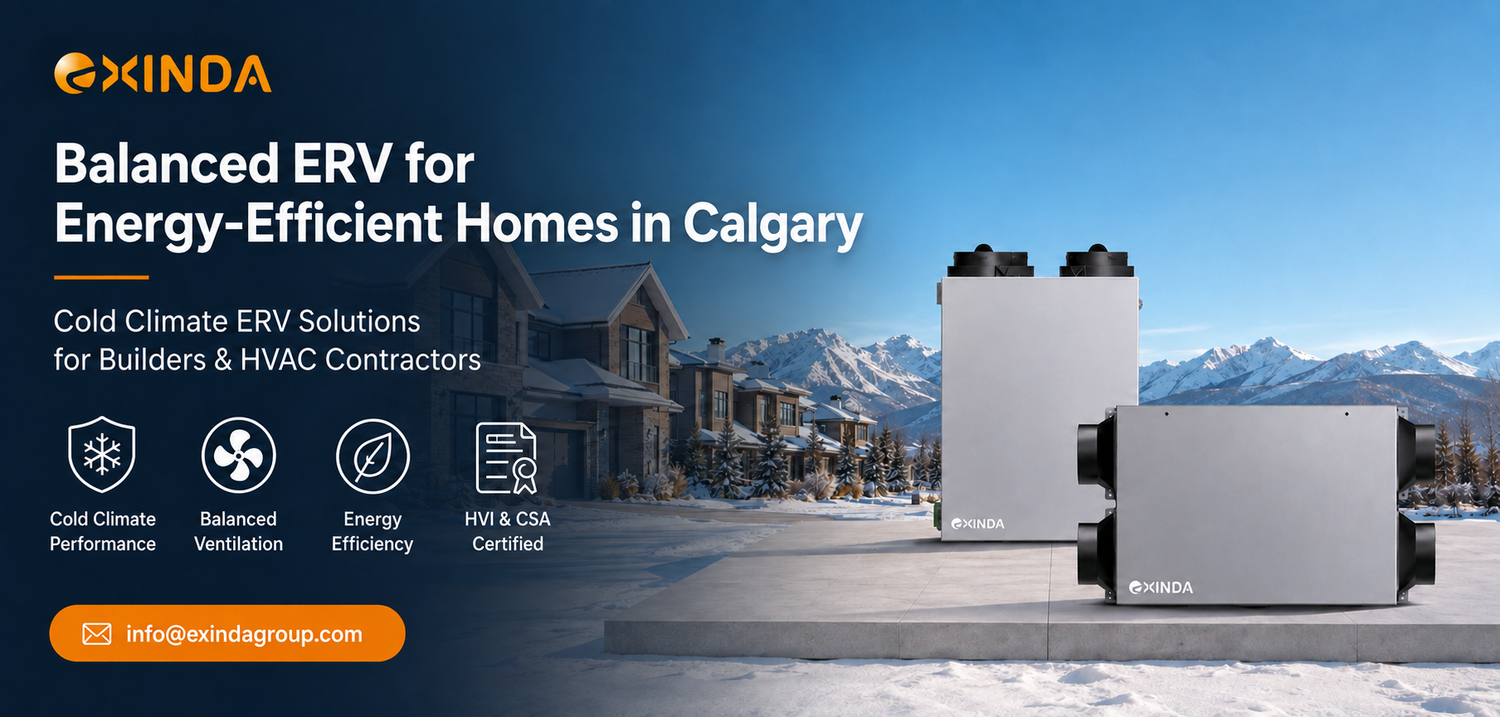
Balanced Ventilation for Energy-Efficient Homes in Calgary: A Cold Climate ERV Solution for Builders and HVAC Contractors
Calgary’s energy-efficient homes are becoming better insulated and more airtight. While this reduces heat loss, it also reduces natural air exchange. A properly designed mechanical ventilation system is therefore essential for bringing in fresh air and removing stale indoor air.
A balanced Energy Recovery Ventilator, or ERV, supplies outdoor air and exhausts indoor air at controlled rates while recovering heat and moisture between the two airstreams.
For Calgary builders, HVAC contractors and engineers, the right ERV must provide:
- Required airflow at the actual duct resistance
- Balanced supply and exhaust airflow
- Reliable cold-weather and frost-control operation
- HVI-certified performance
- CSA-certified electrical safety
- Clear technical and installation documentation
What Calgary’s Building Requirements Mean for ERVs
Calgary currently follows the National Building Code – 2023 Alberta Edition.
Section 9.32 covers residential ventilation, while Section 9.36 addresses energy efficiency for houses and small buildings.
The Code does not require every Calgary home to use an ERV by product name. However, it does require a compliant ventilation system. For airtight, energy-efficient homes, a balanced ERV is a practical way to provide controlled fresh air while reducing ventilation-related heat loss.
| Requirement | What It Means for ERV Selection |
|---|---|
| Design airflow | The ERV must meet the required residential ventilation rate |
| Airflow balance | Supply and exhaust airflow should be measured and balanced after installation |
| Duct resistance | Required airflow must be available at the project’s external static pressure |
| Energy performance | Recovery efficiency must be reviewed at relevant airflow and test conditions |
| Electrical safety | CSA certification must be verified for the exact model |
| Mechanical permit | Calgary HVAC installations require the applicable mechanical permit |
For homes with one to five bedrooms, Section 9.32 normal ventilation rates generally range from approximately 34 to 95 CFM, depending on bedroom count and system design.
The final ERV selection must also consider kitchen and bathroom exhaust, furnace integration, duct layout, controls and project-specific requirements.
Why Balanced Ventilation Matters in Calgary
Calgary is classified as Climate Zone 7A, which means it has a long, cold heating season and high annual heating demand.
Introducing untreated outdoor air during winter can increase the load on the heating system. An ERV reduces this impact by recovering heat from outgoing indoor air before it leaves the building.
A balanced system also helps prevent excessive building pressure.
Too much exhaust airflow can create negative pressure, drafts and uncontrolled cold-air infiltration. Too much supply airflow can create positive pressure and drive indoor moisture into the building envelope.
Balanced ventilation is therefore an installed result—not simply a product description. Even ERVs with constant-airflow or automatic-balancing controls should be measured and verified during commissioning.
HVI Certification and CSA-Certified Electrical Safety
HVI certification and CSA certification serve different purposes.
HVI certification verifies residential ventilation performance, including airflow and energy-recovery data under defined test conditions.
CSA certification verifies electrical safety for installation in Canada.
For professional projects, contractors and engineers should verify that the exact model appears in the applicable HVI and CSA documentation. Certification should not be assumed based on another model in the same product series.
EXINDA provides designated residential ERV models with both HVI-certified performance and CSA-certified electrical safety.
Why EXINDA Breeze ERVs Fit Calgary Projects
EXINDA Breeze ERVs are designed for North American residential and multifamily applications.
Cold-Climate Operation
Applicable EXINDA ERVs have documented operation down to −25°C, with frost-control strategies designed for cold-weather ventilation.
The exact operating temperature and defrost sequence should always be confirmed in the selected model’s submittal.
Multiple Airflow Options
EXINDA provides residential ERV options from approximately 50 to 170 CFM, supporting:
- Detached homes
- Townhomes
- Secondary suites
- Condominiums
- Multifamily residential projects
The range allows engineers and contractors to match the ERV to the required airflow instead of using one oversized model for every home.
Stable Airflow Performance
ECM constant-airflow technology on applicable models helps maintain the selected airflow when duct resistance changes.
The project team should still verify the unit’s airflow at the expected external static pressure and measure the final airflow after installation.
Flexible Installation
EXINDA offers top-port and side-port ERVs for different mechanical-room and duct-layout requirements.
This flexibility can reduce unnecessary duct fittings, simplify installation and improve service access.
Project Documentation
EXINDA supports Calgary contractors, builders and engineers with:
- HVI performance data
- CSA certification documents
- Airflow tables
- External static pressure information
- Technical submittals
- Dimensional drawings
- Installation manuals
- Frost-control descriptions
- Model-selection and balancing support
Calgary ERV Selection Checklist
Before specifying an ERV, confirm:
- Required residential ventilation airflow
- Estimated external static pressure
- Net airflow at the required pressure
- Supply and exhaust airflow balance
- HVI listing for the exact model
- CSA certification for the exact model
- Minimum operating temperature and defrost sequence
- Port arrangement and service clearances
- Final airflow measurement and commissioning
Frequently Asked Questions
Does every Calgary home need an ERV?
Not necessarily. The Code requires compliant ventilation performance but does not prescribe an ERV for every home. ERVs are commonly selected for airtight, energy-efficient homes because they combine balanced ventilation with energy recovery.
Is HVI certification enough for installation in Alberta?
No. HVI verifies ventilation performance. CSA-certified electrical safety must also be confirmed for the exact model.
Can an EXINDA ERV operate at −25°C?
Applicable EXINDA models have documented operation down to −25°C. The exact operating limit and defrost sequence must be verified in the model-specific submittal.
Does automatic airflow control eliminate field balancing?
No. It can improve airflow stability, but the installed supply and exhaust airflow should still be measured and documented.
Choose a Project-Ready ERV for Calgary
The right balanced ERV for an energy-efficient Calgary home must match the required airflow, operate against the actual duct resistance, carry HVI certification and CSA-certified electrical safety, and perform reliably during cold-weather operation.
EXINDA works with Alberta HVAC contractors, builders, distributors and engineers to provide project-ready residential ERV solutions.
Contact info@exindagroup.com to request:
- ERV technical submittals
- HVI and CSA certification documents
- Model-selection support