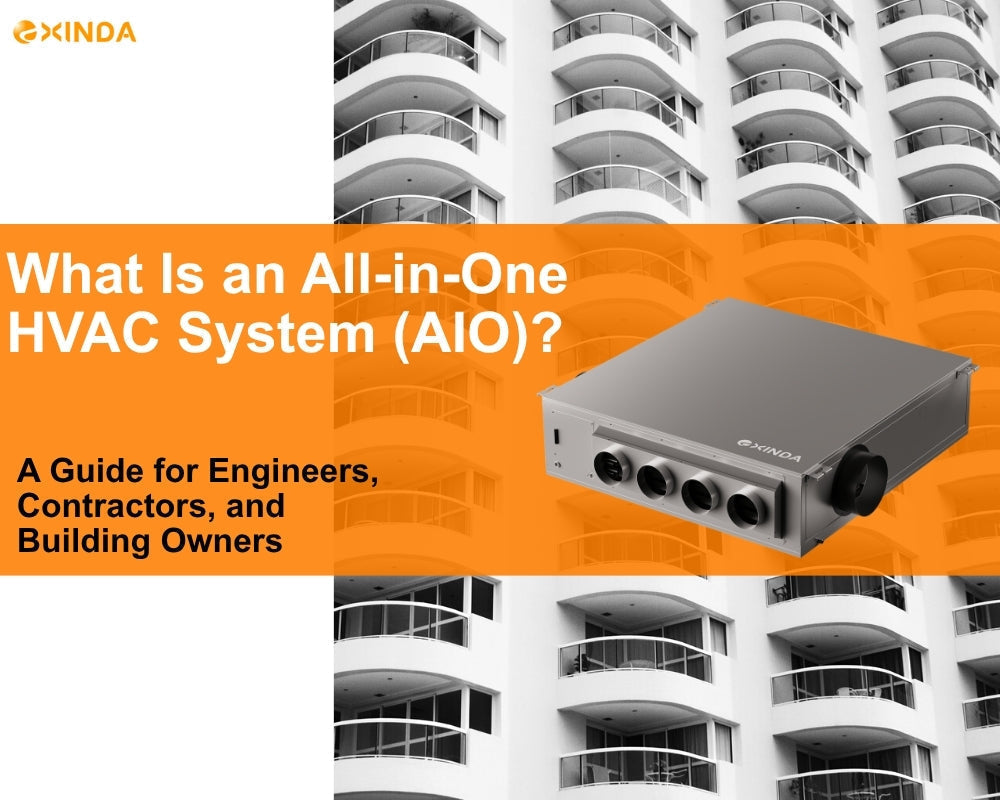
More engineers, developers and building owners are searching for "all-in-one HVAC" systems, often referred to as AIO units, that provide heating, cooling and ventilation in one piece of equipment. This page explains what the term covers, why the market is moving that way, and where the EXINDA Aura HPERV fits.
The traditional HVAC system problem
In many multifamily and commercial buildings, HVAC is still designed from separate components: boilers for heating, chillers for cooling, cooling towers, energy recovery ventilators, pumps and hydronic distribution, domestic hot water, and separate controls for each.
It works, but it costs: large mechanical rooms, high installation cost, complex piping and wiring, several contractors to coordinate, long installation time, and equipment that is harder to service. That is why the market is moving toward integrated systems.
What is an all-in-one HVAC system?
An all-in-one HVAC system combines several functions in one engineered unit: space heating, space cooling, fresh-air ventilation, heat recovery, and controls, sometimes with domestic hot water. Instead of installing a boiler, a chiller and an ERV separately, one system does the work.
It suits multifamily buildings, condominiums, hotels, student housing, senior living, offices, schools and mixed-use developments.
Why the market is moving toward all-in-one systems
- Less mechanical room space. Combining systems reduces the footprint of the equipment.
- Lower installation cost. Less piping, less electrical work, fewer controls to integrate, less labour.
- Simpler design. The engineer designs one integrated system instead of coordinating several.
- Efficiency. Heat pump technology and heat recovery ventilation in one system improve overall efficiency.
- Easier maintenance. One main system to maintain instead of several.
Packaged vs. centralized all-in-one systems
Packaged (terminal) units are installed in each apartment or room, with no outdoor condensing unit. They are common in apartments and hotels; the EXINDA Aura HPERV is this type.
Centralized systems sit in a mechanical room or on the roof and serve the whole building, usually through a water loop. They suit larger mid- and high-rise buildings where a central plant is preferred.
EXINDA Aura HPERV: a packaged all-in-one heat pump ERV
The Aura HPERV is a ceiling-ducted heat pump with an energy recovery ventilator built into the same cabinet. It provides heating, cooling and filtered fresh air from a single indoor unit, designed for high-static residential duct systems and high-rise applications.
- External static pressure for real duct runs. Rated 430 CFM heating / 400 CFM cooling at 0.30 in. w.g., enough for typical multi-branch apartment ductwork.
- No outdoor unit. Heating, cooling and ventilation are all inside one indoor cabinet.
- Two small exterior openings. One intake, one exhaust, suited to window-wall and high-rise facades.
- Fresh air built in. ERV core with MERV 13 filtration on the incoming air and a bathroom exhaust connection.
- Built for apartments. Studios, one-bedroom suites and compact multi-room ducted layouts.
Rated data, fan curves and duct sizing are on the Aura HPERV product page. To compare the packaged options on the market, see All-in-one heat pumps with no outdoor unit for apartments: how to choose.
Conclusion
All-in-one HVAC systems are becoming a real trend as buildings get more complex and construction costs keep rising. Integrating heating, cooling and ventilation into one system cuts installation cost, saves space and simplifies design, and packaged units with no outdoor unit are the version most multifamily projects will see first.