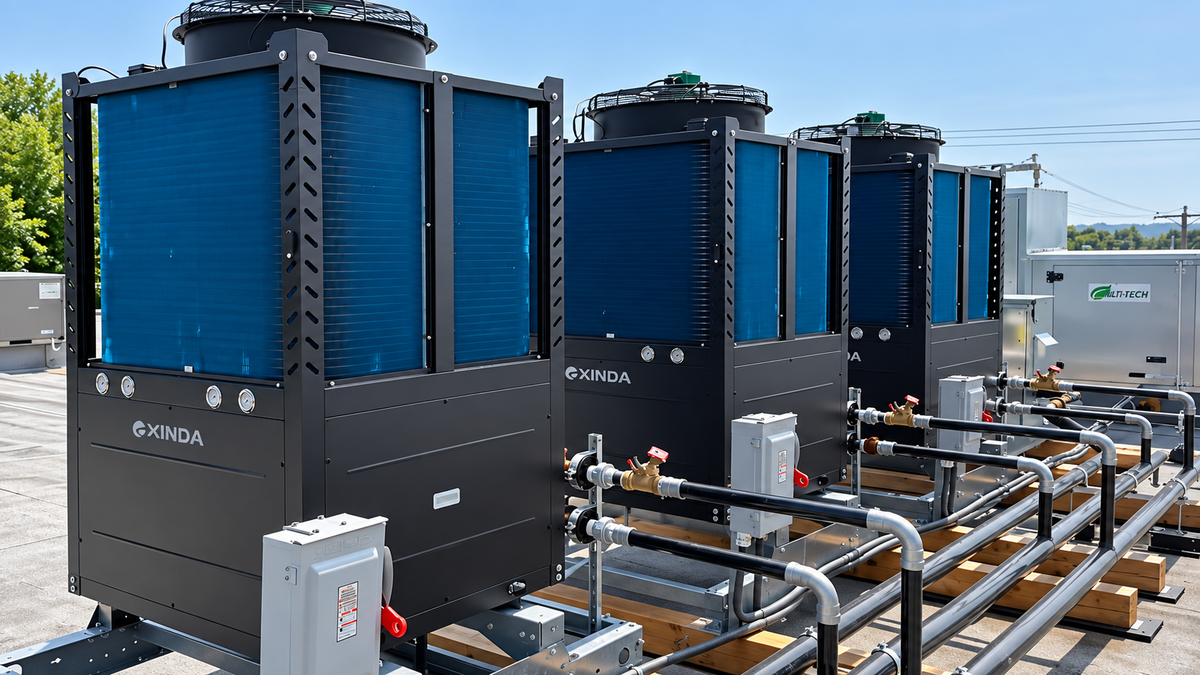
A single 12-ton EXINDA air-to-water heat pump has heated a building in Montréal since 2025, feeding an existing in-floor radiant slab at a 35°C supply temperature through a plant room built around two thermal storage tanks. The building's original gas boiler was kept, not removed — locked out until the outdoor temperature falls below −25°C. In practice it rarely fires.
EXINDA FLEX 12 Ton R32 Modular Heat Pump Chiller ↗
Nothing in the Building Had to Change
The radiant slab was already in the floor and the gas boiler was already in the plant room. The heat pump did not ask the building to convert anything: it took over the boiler's job and left the emitters, the pipework and the boiler itself where they were.
That is possible because of the temperature the slab runs at. A radiant floor delivers heat over the whole floor area, so it asks for water at around 35°C rather than the 70°C and above a cast-iron radiator system was designed around. Every degree of supply temperature the terminals do not need is a degree the compressor does not have to lift.
Manifolds and PEX loops into the slab. The slab was already there; only the heat source changed.
Montréal's winter design temperature sits in the region of −23°C to −25°C depending on the site and the design criterion. The unit is published to operate down to −25°C (−13°F) and to produce leaving water up to 60°C (140°F). Asking it for 35°C means the temperature lift stays modest even on the coldest days of the year: the demanding part of the envelope here is the outdoor air, not the water.
A boiler retrofit on high-temperature radiators is a harder project, and a different product. A boiler retrofit on a radiant slab is the easy end of the same problem — which is why it is worth identifying buildings that already have one.
One Unit Outside, Raised Clear of the Snow
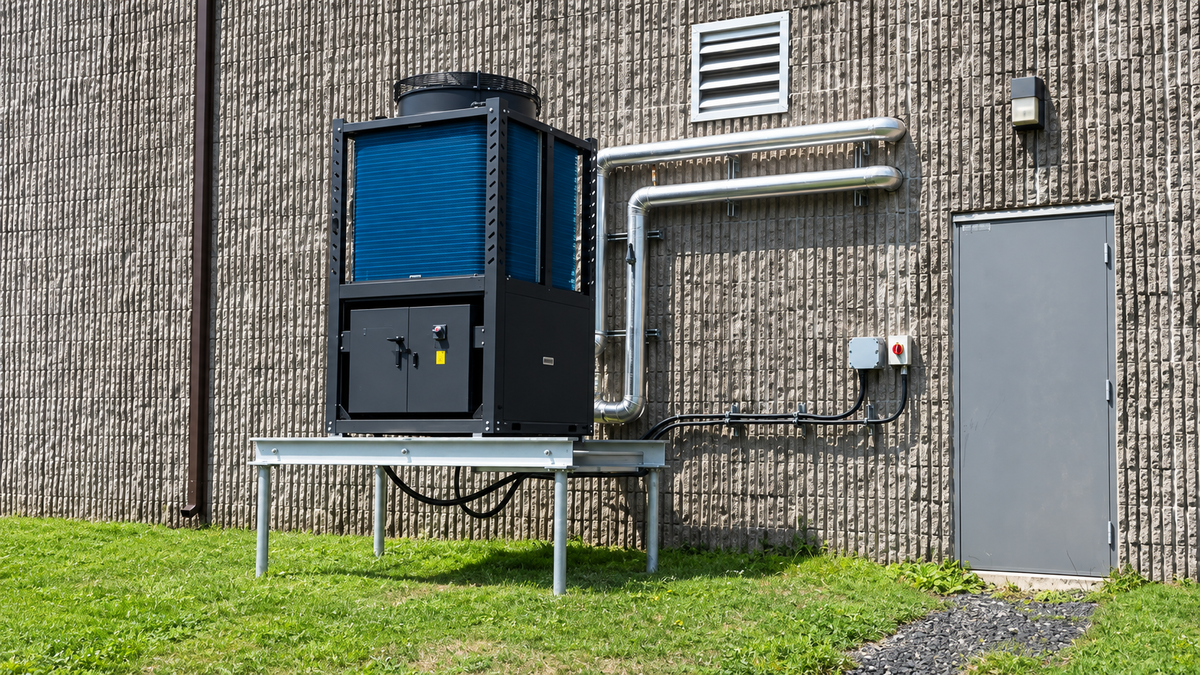
The heat pump is mounted on a galvanized steel stand rather than set on a slab at grade. In Montréal that height is not cosmetic. It keeps the coil above drifting snow, gives meltwater somewhere to go, and keeps the base out of the ice that forms and re-forms under a unit defrosting through a long winter.
The unit stands clear of grade on a galvanized steel frame, with insulated mains and an external disconnect at the wall penetration.
Insulated supply and return mains run up the wall and through a single penetration, with an external disconnect beside it. Everything needed to isolate the unit is reachable from outside the building, in February, without going through the plant room first.
What the Thermal Storage Is For
Two thermal storage tanks carry the system's water volume. This is the part of a heat pump plant room that gets value-engineered out first and causes the most trouble afterwards.
Two thermal storage tanks, circulators, air separation, balancing valves with flow meters, and thermometers on both supply and return.
A heat pump does not want to start and stop. Short cycling costs efficiency, wears the compressor and makes defrost behaviour erratic. Water volume is what prevents it: the tanks give the system enough thermal mass that the compressor runs in long, stable periods instead of chasing every small change in zone demand. They also give the unit somewhere to draw heat from during a defrost cycle, so the slab is not robbed of energy each time the outdoor coil clears.
A slab is slow by nature and does not want short bursts of hot water. Storage and radiant suit each other for the same reason they both suit a heat pump: everything in the system prefers to run steadily at a low temperature.
The rest of the plant room is built for verification rather than appearance. Thermometers sit on supply and return, balancing valves carry flow meters, and each circuit can be isolated. Someone servicing this system in five years can read what it is doing without instrumenting it first.
The Switchover Point Is −25°C
There is no electric auxiliary heater in this system. The heat pump is the heating plant, and the building's original gas boiler is retained as the backup heat source, locked out until the outdoor temperature falls below −25°C.
That number is not arbitrary. −25°C (−13°F) is the heat pump's published operating limit, and it sits at or below Montréal's winter design temperature. The control logic therefore hands over to the boiler only when the weather has gone past both the design condition and the equipment's rated envelope. Everything inside the envelope is the heat pump's work.
The consequence is visible in operation: the boiler rarely fires. Run hours are not metered on this installation, so that is an operator observation rather than a measured figure, but it follows directly from where the switchover was set. A single 12-ton unit at a 35°C supply temperature has been carrying this building's heating load in Montréal, with the gas boiler behaving as insurance for the few hours a year that fall outside the design case.
The question worth asking on any bivalent design is not whether a backup exists but where the switchover sits. Set it at 0°C and the boiler is doing a large share of the heating and belongs in the energy model as a heating plant. Set it at the equipment's rated limit, as here, and the backup stays a backup — and the gas the building still burns is limited to the tail of the winter.
Keeping the existing boiler also removed two of the usual obstacles to electrifying a heating plant. The project did not have to size the heat pump for the extreme tail of the winter, and it did not have to bring in the electrical service that an all-electric design at this load would have required. The trade is that the building keeps a second heating system to maintain, and keeps a gas connection.
Where This Configuration Applies — and Where It Doesn't
The 35°C supply temperature in this case is a property of this building's slab, load and flow rate, not a rated parameter of the equipment. Another project will arrive at a different number.
This arrangement suits projects where:
- the terminals are radiant slabs or other low-temperature emitters already in place
- an existing boiler can be retained rather than removed, giving a second energy source for the hours below the design temperature
- a single unit can cover the design load, with storage volume rather than module staging providing stability
- plant room space exists for tanks, or can be found
- the outdoor unit can be raised clear of snow with year-round service access maintained
It is not the right starting point for a building on existing high-temperature radiators. Those projects should be reviewed against the FLEX R515B range, which supplies hot water up to 85°C (185°F).
For an all-electric project with no combustion backup at all, where capacity was assembled from four modules rather than one unit and the terminals asked for 45–50°C instead of 35°C, see Two Winters on a Québec Rooftop. For how storage volume is sized, see Modular Heat Pump Water Volume Sizing.
Discuss Your Project
Tell us your winter design temperature, heating load, terminal type, existing heat source and required supply and return temperatures, and we will provide performance data at your project's conditions.