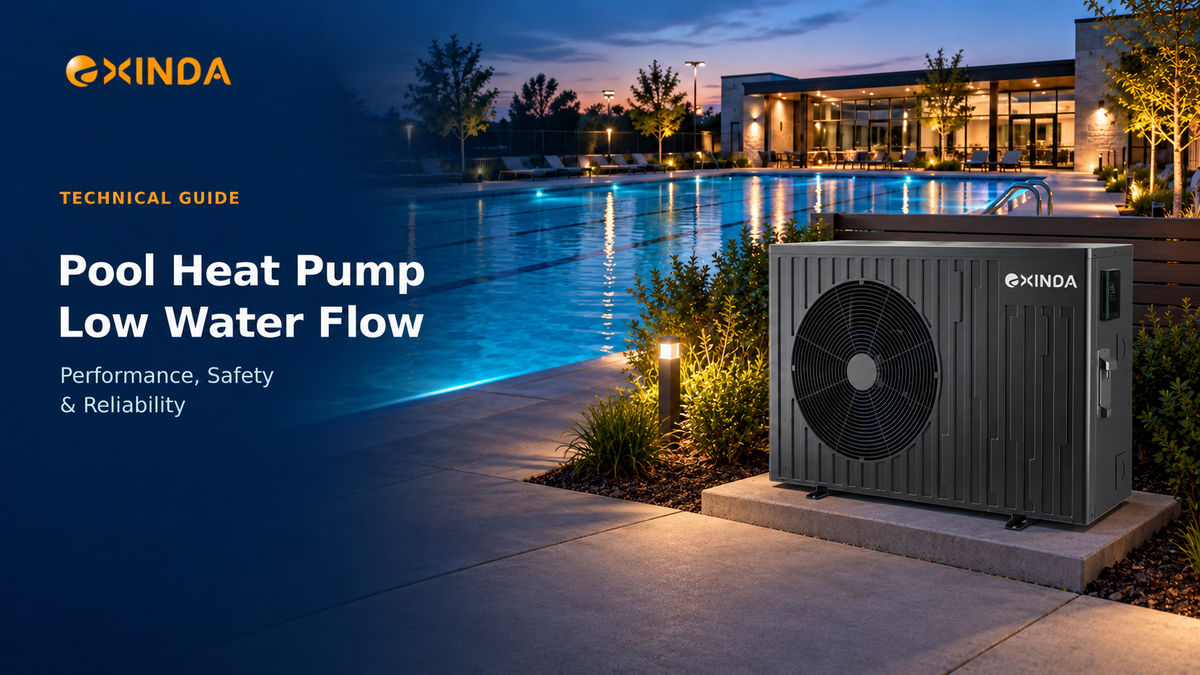
Pool heat pump low water flow reduces the amount of heat that can be transferred into the pool water. If the condition continues, refrigerant pressure and discharge temperature may increase, protection devices may stop the unit, and repeated operation near the protection limit may affect long-term reliability.
For distributors, contractors and service technicians, a low-flow fault should not be treated simply as a flow-switch problem. The complete hydraulic system—including the circulation pump, filter, pipe diameter, valves, bypass setting and heat exchanger pressure drop—must be evaluated.
Why Does Water Flow Matter in a Pool Heat Pump?
A pool heat pump extracts heat from the outdoor air and transfers it to the circulating pool water through a refrigerant-to-water heat exchanger.
The water flowing through the heat exchanger carries this heat back to the pool. When the water flow rate falls below the intended operating range, less water is available to absorb the heat produced by the refrigeration system.
This can lead to:
- A larger temperature difference between inlet and outlet water
- Higher refrigerant condensing pressure
- Higher compressor discharge temperature
- Increased compressor and inverter load under some conditions
- High-pressure or water-flow protection
- Reduced heating output
- Unstable operation or repeated cycling
The exact response depends on the heat pump model, compressor speed, entering-water temperature, outdoor conditions and actual flow rate.
How Does Low Water Flow Affect Heating Performance?
Low water flow does not necessarily mean the pool water will heat faster because the outlet temperature is higher.
When flow decreases, each volume of water remains in the heat exchanger longer, so the measured outlet-water temperature may rise. However, the total volume of heated water returning to the pool is reduced.
The useful heat delivered to the water is related to three factors:
Heat output = water flow × temperature rise × water heat capacity
A high outlet-water temperature therefore does not prove that the unit is producing more total heating capacity. If the flow becomes too low, the heat pump may reduce compressor speed or stop on protection before it can deliver its intended output.
For system evaluation, technicians should consider both the measured water flow and the inlet-to-outlet temperature difference—not either value alone.
Can Low Water Flow Cause High-Pressure Protection?
Yes. Pool heat pump low water flow can contribute to high refrigerant pressure during heating operation.
When water cannot remove heat from the condenser quickly enough, the condensing temperature and pressure may rise. The controller may respond by reducing compressor frequency or stopping the heat pump through a high-pressure protection device.
Possible symptoms include:
- Intermittent high-pressure alarms
- Normal startup followed by shutdown
- Compressor frequency increasing and then suddenly decreasing
- Abnormally high outlet-water temperature
- Repeated stopping and restarting
- Longer pool-heating time
- Higher-than-expected power consumption under certain conditions
A high-pressure fault should still be diagnosed systematically. Low water flow is one possible cause, but incorrect refrigerant charge, blocked heat exchanger passages, sensor errors, poor airflow and other refrigeration-system conditions may produce similar symptoms.
Is the Flow Switch Enough to Protect the Heat Pump?
A flow switch is an important safety device, but it should be treated as backup protection rather than a substitute for correct hydraulic design.
Its purpose is generally to confirm that minimum water circulation is present before or during compressor operation. It does not continuously regulate water flow or guarantee that the heat pump is operating at its recommended flow rate.
A system may have enough flow to keep the switch closed but still have less flow than required for stable heat transfer.
The actual flow-switch trip point can also be influenced by:
- Installation orientation
- Pipe turbulence
- Bypass-valve position
- Debris or scale
- Mechanical tolerances
- Switch installation and adjustment
- Rapid changes in pump speed
- Air trapped in the water circuit
For this reason, the protection point should be validated against the heat pump’s operating limits—not assumed from the flow switch alone.
Never bypass or permanently short-circuit a flow switch to keep a heat pump running. Doing so removes an important protective function and may expose the compressor, heat exchanger and electrical components to unsafe operating conditions.
What Commonly Causes Low Water Flow?
| Possible cause | What happens | Recommended check |
|---|---|---|
| Dirty pool filter | Water-side resistance increases | Clean or backwash the filter |
| Blocked strainer or skimmer | Pump suction or circulation decreases | Remove leaves and debris |
| Incorrect bypass setting | Too much water bypasses the heat pump | Adjust according to the installation requirements |
| Partially closed valve | Flow through the unit is restricted | Confirm all valve positions |
| Air trapped in the system | Pump flow becomes unstable | Purge the water circuit |
| Undersized circulation pump | Pump cannot overcome system resistance | Review the pump curve and total head |
| Low variable-speed pump setting | Flow falls below the heat pump requirement | Confirm the minimum permitted pump speed |
| Undersized pipework | Excessive pressure drop limits circulation | Check pipe diameter and equivalent length |
| Long pipe runs or too many fittings | Total dynamic head increases | Calculate system pressure loss |
| Scale or debris in the heat exchanger | Internal water passage becomes restricted | Inspect and clean using an approved method |
| Worn or damaged pump | Actual flow falls below rated performance | Check pump condition and measured flow |
Why Can Low Water Flow Become More Serious in Extreme Conditions?
Low water flow should not be assessed only under mild operating conditions.
A demanding combination may include:
- High outdoor temperature
- High humidity
- High entering-water temperature
- Maximum compressor frequency
- Reduced water flow
- Restricted airflow or contaminated heat-transfer surfaces
Under these combined conditions, compressor current, refrigerant pressure, discharge temperature and the temperature of electrical connections may be higher than during a standard nominal test.
A robust pool heat pump validation program should therefore reduce water flow gradually toward the protection point while monitoring:
- Actual water flow
- Entering- and leaving-water temperature
- Outdoor dry-bulb and wet-bulb temperature
- Compressor current
- Total unit power
- Suction and discharge pressure
- Compressor discharge temperature
- Inverter operating data
- Electrical-terminal and connector temperatures
The objective is to confirm that the heat pump stops or unloads before the compressor, inverter, wiring or other components exceed their permitted operating limits.
This type of combined-condition verification gives distributors more useful evidence than checking the flow switch separately under a single laboratory condition.
Can Repeated Low-Flow Operation Reduce Reliability?
Repeated low-flow operation can create unnecessary thermal and mechanical stress even when each individual event ends in a safety shutdown.
Possible long-term effects include:
- Frequent compressor cycling
- Repeated high-pressure events
- Elevated discharge temperature
- Increased thermal stress on inverter power components
- Heating of terminals, connectors or power cables
- Accelerated wear of contactors and switching components
- Customer complaints caused by intermittent heating
- More service visits for faults originating outside the heat pump
A protection alarm indicates that the controller has reacted to an abnormal condition. It should not be considered a normal method of controlling the system.
Correcting the hydraulic cause is more reliable than repeatedly resetting the heat pump.
How Should Technicians Diagnose a Low-Water-Flow Fault?
Before replacing the flow switch or controller, technicians should check the system in a logical order.
1. Record the operating condition
Record the error code, outdoor temperature, pool-water temperature, pump setting and how long the heat pump operated before stopping.
2. Inspect the basic water circuit
Confirm that the pool contains sufficient water, the circulation pump is primed, the skimmer is clear and the filter does not require cleaning or backwashing.
3. Check valves and bypass settings
Verify that the isolation valves are open and that the external bypass is not directing excessive water around the heat pump.
4. Measure actual water flow
Do not rely only on the pump nameplate. Compare the measured flow with the requirement published for the selected heat pump model.
5. Measure the water-temperature difference
An unusually large inlet-to-outlet temperature difference may indicate insufficient flow, although the acceptable value depends on the model and operating condition.
6. Inspect the flow switch
Confirm correct installation, wiring, orientation and mechanical movement. Check for debris, poor electrical contact or an improperly secured connection.
7. Review the complete system pressure drop
If the fault returns, calculate the resistance of the filter, heater, chlorinator, valves, pipework and fittings. Confirm that the pump can provide the required flow at the calculated total dynamic head.
What Should Distributors Confirm Before Selecting a Pool Heat Pump?
A pool heat pump should be selected together with the hydraulic system rather than treated as an isolated appliance.
Before recommending a model, confirm:
- Pool volume and required heating time
- Target water temperature
- Outdoor design conditions
- Presence and type of pool cover
- Circulation-pump model and pump curve
- Pipe diameter and approximate pipe length
- Filter and sanitation equipment
- Planned bypass arrangement
- Required water flow for the selected heat pump
- Available electrical supply
- Installation and service clearances
For multi-unit or commercial installations, hydraulic balancing becomes especially important. Units connected in parallel should receive suitable flow individually, and the control sequence should prevent a heat pump from operating without confirmed circulation.
How EXINDA Approaches Water-Flow Protection
EXINDA pool heat pumps are developed for residential, distribution and project applications, with model selection and water-system requirements reviewed according to the intended market and installation.
Depending on the selected model and configuration, EXINDA pool heat pump solutions may include:
- Corrosion-resistant titanium water heat exchangers
- Water-flow monitoring and fault protection
- Inverter compressor control
- Operating-condition monitoring
- Installation and service documentation
- Technical support for pump and piping selection
- OEM and private-label configuration support
For North American projects, EXINDA offers R32 pool heat pump options across multiple capacity classes. Product features, ratings and certifications must be confirmed against the published documentation for the specific model and market.
When evaluating an application, EXINDA can review the expected pool load, hydraulic arrangement, circulation-pump information and installation conditions before recommending a suitable configuration.
Frequently Asked Questions
What happens when water flow is too low in a pool heat pump?
Low water flow limits heat transfer from the refrigerant to the pool water. It can increase the water-temperature difference, raise refrigerant pressure and trigger water-flow or high-pressure protection.
Can a dirty pool filter cause a heat pump to stop?
Yes. A dirty filter increases water-system resistance and may reduce circulation below the heat pump’s operating requirement or flow-switch threshold.
Does a higher outlet-water temperature mean better heating?
Not necessarily. A high outlet temperature combined with low flow may deliver less total heat to the pool. Heating performance depends on both water flow and temperature rise.
Can a variable-speed pool pump cause low-flow faults?
Yes. If its programmed speed is too low, the pump may not provide sufficient flow after accounting for the filter, pipework, valves and other equipment. The minimum operating speed should be verified with actual system flow.
Should the pool heat pump flow switch be bypassed?
No. Bypassing the flow switch removes an important safety function. The hydraulic or electrical cause of the fault should be identified and corrected.
Why does the heat pump run after filter cleaning but stop again later?
The system may be operating close to its minimum flow requirement. As the filter collects debris, resistance increases and the flow falls below the safe operating range. Pump selection, pipe resistance and bypass settings should be reviewed.
What information does EXINDA need for pool heat pump selection?
EXINDA normally requires the pool volume, location, target water temperature, heating season, pool-cover information, circulation-pump data, pipe arrangement, electrical supply and required heating time.
Request a Pool Heat Pump Selection Review
If you are a pool equipment distributor, contractor, project developer or OEM partner, EXINDA can help review your pool-heating load, water-flow requirements, pump arrangement and suitable model range.
Send your project location, pool dimensions, target temperature, circulation-pump information and electrical supply to info@exindagroup.com for a technical selection or distribution discussion.